Showing posts with label 1960. Show all posts

Tuesday, 14 November 2017

Monaco 1977 - The Career of a Navigator 1st Issue (Part 1)

He was born into royalty, but he possessed the heart of a scientific explorer with a passion for the relatively new field of oceanography. Honoré Charles Grimaldi, later Prince Albert I of Monaco, was born 13 November 1848. His love for the ocean was perhaps cultivated while he was still a young man serving in the Spanish Navy. Then during the Franco-Prussian War (19 July 1870 – 10 May 1871) he joined the French Navy. In this capacity he excelled, earning himself the Legion of Honour. 

Throughout his life, Prince Albert's love for oceanography was evident in nearly every aspect of his life, but he also had a keen interest in unravelling the mysteries of the origins of man. In fact, he founded the Institute for Human Paleontology. The institute went on host a number of archaeological digs. During one such dig "Grimaldi Man" was found in the Baousse-Rousse cave, and it was named in his honour. 

As a skilled navigator and a trail-blazer in the burgeoning field of oceanography, Prince Albert devoted his life to the study of oceans and aquatic life. In all, he led 28 scientific expeditions around the Mediterranean, to the Azores, and even an adventure to the Arctic. In order to make the most of these research expeditions, he had several ships retro-fitted with high-tech (for the time) scientific equipment. He had four ships in total: Hirondelle, Princess Alice, Princesse Alice II and Hirondelle II. But what is field research without a home base? To this end, he founded the Oceanographic Institute in 1906, which is comprised of two establishments: the Oceanographic Museum in Monaco (for which there was a lovely stamp series issued) and the Home of the Oceans in Paris.

Housed within the Oceanographic Museum is the Salle Albert I, an exhibit dedicated to his exceptional career as a navigator and oceanographer. It houses numerous marine specimens, photos, and a library of scientific analysis. It also includes several display models, including miniatures of his research ships and even a full size sperm whale!  

***

In 1902 Albert I published a book La Carriere d'un Navigateur (The Career of a Navigator), which documents his adventurous life at sea. In 1977, the 75th anniversary of the publication of his magnum opus, Monaco issued a glorious set of 18 stamps, issued in two sets of nine, honouring the Prince's achievements.. The first set, which I will focus on in this blog, was issued 3 May 1977.  To engrave this mammoth issue, a stellar cast of French engravers was enlisted: Pierre Gandon, Claude Haley, Michel Monvoisin, George Betemps, and Pierre Forget. They even brought in a top gun outsider a fellow whose name you may have heard of one or twice - Czeslaw Slania! This set was created based on illustrations by the French illustrator Louis Tinayre (14 March 1861-26 September 1942).

***

Considering this set is so big, I have broken it into two separate blog posts. This week we will study the first four stamps of the nine, and next week we will see the remaining five, and I might even be able to find a few more tidbits about Prince Albert I. So without further ado...

***

The 0,10f stamp was designed and engraved by Pierre Gandon. It features L'Hirondelle, Prince Albert I's schooner.


***

The 0.20f stamp was designed and engraved by Czeslaw Slania (although not a French engraver, I include the stamp so the entire set can be perused). It features the portrait of Prince Albert I.


***

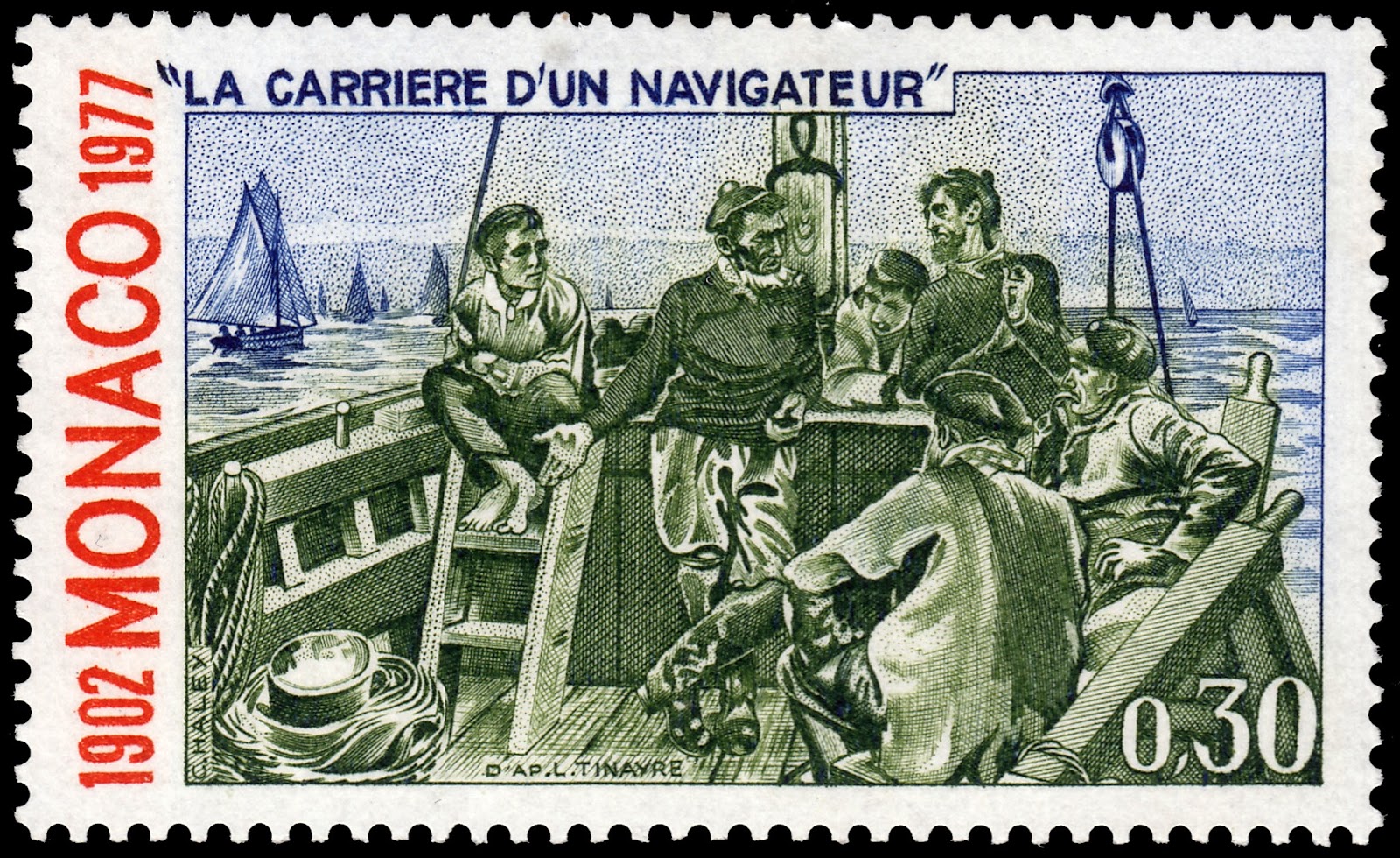
The 0,30f stamp was designed and engraved by Claude Haley. It features a lovely moment being shared by the crew members aboard one of Prince Albert I's research vessels.


***

The 0,80f stamp was designed and engraved by Michel Monvoisin. It features a splendid action shot of L'Hirondelle battling some rough weather. That wave in the background sure does look menacing!


Stay tuned for Part 2 of this gorgeous set next week!

Until then...
Thursday, 6 July 2017

I Muse... On An Intriguing Journey

I am continually fascinated by the amazing stories a postal cover can tell us, its route, the places it passes through, and even the times of arrival and departure from said places. And of course the stamps affixed to the cover can also tell a story. Recently I purchased a cover that, in my opinion, has a fantastic tale to tell. Let's listen closely to see what it has to say...

Before the full cover is revealed, first, let's consider the stamps affixed to the cover. 


On the left we have a stamp featuring an Morane-Saulnier MS 760 light aircraft. This stamp was issued 11 January 1960 as part of a four stamp Airmail series. The stamp was designed and engraved by Pierre Gandon. Incidentally, this is the second printing of this stamp. It was first issued 16 February 1969, bearing a value of 300f (old francs). The stamp on the right features the Isle of Gosier, Guadeloupe. It has a face value of 1f and was issued on 22 June 1970. This lovely stamp was designed and engraved by Pierre Béquet.  These two stamps give the cover a total face value of 4f.

***

Now we can reveal the entire cover!


A beauty, isn't it! Immediately apparent from the front of the cover is that it was sent express, which probably accounts for the high franking of 4f, and that it was sent to two different locations. But more on that in a moment. From the two cancels tying the stamps to the cover, we see that it was posted on 17 August 1971 from La Faloise, Somme at 4pm. Interestingly, one of the stamps on this cover is over ten years old! Perhaps pulled from an old horde?

***

Now we can turn our attention to the reverse of the cover in order to decipher the journey it took.


According to the cancels, the cover's first trip took place between 17-18 August. It left Somme at 4pm and arrived at Paris Gare du Nord at 8pm. Later that night it then left Paris Gare du Nord at 11:30pm. Its next destination was Rueil-Malmaison (Ile de la Cite, Paris) on the 18 August at 6am. The map below gives an idea of its journey.


Then something happened. Either the person was no longer at that address or they wanted the letter sent on. Whatever the case, the cover was again checked in at Rueil-Malmaison post office and was on its way again at 4:45pm that same afternoon.

Now the cover takes a much longer journey, all the way to 74 Boulevard Chanard, Quiberon, where it arrives on the 20 August at 7pm. See the map below.


***

Interestingly, the cover seems to have had a short stopover at a sorting centre. Unfortunately I am unable to work out where the sorting centre is. If anyone out there has any idea where the below sorting centre is located, I'd love to hear from you.


Wow! What a journey. This is precisely why I love covers so much.

Until next time...

Friday, 14 April 2017

France 1959 - The MS 760 Paris

Watching the movie Those Magnificent Men in their Flying Machines as a kid fascinated me. Seeing the fantastic array of early aircraft got me well and truly hooked on aviation history. Since that day I've been captivated by the evolution of aircraft and the talent behind the different designs that grace our skies.

***

The French aircraft company Aéroplanes Morane-Saulnier has a rather interesting history. It was founded in 1911 by Raymond Saulnier and the Morane brothers, Leon and Robert. The first plane this company produced was the Model A (also called the Morane-Borel), a monoplane design. This design used a wing-warping mechanism for control. This method of controlling the aircraft was developed by the Wright Brothers and first used on the Wright Flyer  in 1903. The Model A proved to be a cut above the rest when on 26 May 1911 it won the Paris to Madrid Race. The winning pilot was Jules Védrines. Below is a great pic of a Model A c. 1911.


The success of the Morane-Saulnier company continued with the Type G, the first commercially successful design, This was another monoplane with wing warping technology. This series of aircraft had a very successful racing career, setting numerous records. Originally a two-seater, the Type G was tweaked a bit and turned into a single seat fighter plane, known as the Type N. Speaking of fighting, it is interesting to note that the Morane-Saulnier company played a significant role in the development of the technology allowing a machine gun to fire through a propeller without destroying it, using what was called a Synchronisation Gear. This revolutionary technology changed the face of aerial combat in World War I.

In the early 1950s, responding to the needs of the French Air Force, the Morane-Saulnier company began designing jet trainers. Their first design, the MS.755 Fleuret, was not as effective as hoped, so they went back to the drawing board. What resulted from this was the sleek-looking four-seat aircraft, MS 760 Paris. This aircraft was used by the French Defence Forces, and it was also sold to Argentina and Brasil for use in their Air Forces.
***

On 16 February 1959 France issued an airmail stamp featuring the MS 760 Paris. Incidentally, this was the last stamp issued in a series of airmail stamps that began in 1954. The stamp had a face value of 300f and it was designed and engraved by Pierre Gandon.


The detail is of lovely design is excellent. We can even see the four people sitting in the cabin.


***

In 1960 the franc was revalued and called the "New Franc".100 Old Francs became 1 New Franc, or NF. With this revaluation new airmail stamps were required. This lovely stamp was re-issued with a new 3f value.


Until next time...


Sunday, 10 January 2016

Monaco 1960 - 50th Anniversary of the Oceanographic Museum

In 1960 Monaco issued a set of six stamps to commemorate the 50th Anniversary of the Monaco Oceanographic Museum. One of the stamps in this set was engraved by Albert Decaris.

***

The Monaco Oceanographic Museum is located in Monaco-ville, and the building itself is built into the side of a cliff face overlooking the ocean. It is an amazing building in the baroque revival style, and it took workers some eleven years to complete.


***

The museum was inaugurated in 1910 by Monaco's Prince Albert I. In looking up the history of the museum, I was surprised to discover that the great Jacques Cousteau was the director of the museum from 1957 to 1988. I recall watching Mr Cousteau on TV as a kid. The singer/songwriter John Denver wrote a song dedicated to him, called Calypso, which was the name of Cousteau's boat. The museum is also known as the Jacques Cousteau Museum.

The museum is home to a large variety of sea fauna such as starfish, turtles, sea urchins ,jellyfish, crabs, sharks, lobsters and many more sea critters. There are even some skeletons!


It is also home to an amazing octopus sculpture.


***

Of the six stamps in the set, the one engraved by Decaris is rather striking...


In the background we find the façade of the museum. and in the foreground various Cephalopods are displayed, swimming around an oscilloscope, a device used to study the electrical properties of marine life.

Until Next time...