Showing posts with label Haley (Claude). Show all posts

Wednesday, 19 June 2019

France 1979 - Tourism Series (Part 5)

The last battle of the Breton War of Succession was fought here in 1364. In 1776, at the beginning of the US War of Independence, Benjamin Franklin came through here in his way to meet with Louis XVI to seek military aid. In 1795, 750 rebels were shot and buried here. Its train station was of vital strategic importance during WWII. Its inhabitants are called Alréens. This is Auray, a commune in the Morbihan department in Brittany, northwestern France. Aside from its rather checkered history, Auray is home to some breathtaking architecture. From bridges and fountains to churches and stunning timber houses, a stroll through the city is well worth it.

***

On 9 July, 1979, France issued a set of seven stamps in their ongoing Tourism series. To read the previous four parts, simply click on the relevant link. Part 1. Part 2. Part 3. Part 4 In this blog I'll take a close look at the 1,00 stamp, which depicts a gorgeous wooden house in the town square of Auray. This stamp was designed and engraved by Claude Haley. This particular stamp is quite special in that it won Haley the 1979 Philatelic Art Grand Prize. A very worthy winner. This stamp is crammed with an amazing level of detail.


Until next time...


Monday, 20 November 2017

Monaco 1977 - The Career of a Navigator 1st Issue (Part 2)

Oceanography is: "a science that deals with the oceans and includes the delimitation of their extent and depth, the physics and chemistry of their waters, marine biology, and the exploitation of their resource" (Meriam-Webster.com).

***

In last week's blog we were introduced to Prince Albert I of Monaco, a trail-blazer in the field of oceanography. His contributions to this discipline and his career as a navigator were celebrated in a sumptuous series of 18 stamps, issued in two sets of nine in 1977.

One of Prince Albert's crowning achievements was the founding of the Oceanographic Institute in 1906. One part of the institute is the Monaco Oceanographic Museum, located in Monaco-ville. The museum is a  stunning piece of architecture in the baroque revival style. It was built into the side of a cliff face overlooking the ocean, and it took workers some eleven years to complete.


***

The museum was inaugurated in 1910 by Prince Albert I. In looking up the history of the museum, I was surprised to discover that the great Jacques Cousteau was the director of the museum from 1957 to 1988. I recall watching Mr Cousteau on TV as a kid. The singer/songwriter John Denver wrote a song dedicated to him, called Calypso, which was the name of Cousteau's boat. The museum is also known as the Jacques Cousteau Museum.

The museum is home to a large variety of sea fauna such as starfish, turtles, sea urchins ,jellyfish, crabs, sharks, lobsters and many more sea critters. There are even some skeletons!


It is also home to an amazing octopus sculpture.


***

In 1902 Albert I published a book La Carriere d'un Navigateur (The Career of a Navigator), which documents his adventurous life at sea. On 3 May 1977, the 75th anniversary of the publication of his magnum opus, Monaco issued a glorious set of 18 stamps, issued in two sets of nine, honouring the Prince's achievements. To engrave this mammoth issue, a stellar cast of French engravers was enlisted: Pierre Gandon, Claude Haley, Michel Monvoisin, George Betemps, and Pierre Forget. This set was created based on illustrations by the French illustrator Louis Tinayre (14 March 1861-26 September 1942).

Last week we kicked off by studying the first four stamps in this first series. This week we will study the last five stamps in this series. And they are truly gorgeous. Maintenant examinons les timbres!

***

The 1f stamp was designed and engraved by Georges Betemps. It features a night-watch helmsman at the wheel of one of Prince Albert's yachts, perhaps l'hirondelle. I love this stamp. The depths of the darkness give it a sense of brooding mystery. And the illumination from the binnacle lamps splashing over the sailor is fabulous.


***

The 1f 25 stamp was designed and engraved by Pierre Forget. It features a dynamic scene in which L'hirondelle battles a raging storm. The artist has managed to create a very real sense of fear and impending danger in this stamp.


***

The 1f 40 stamp was designed and engraved by Claude Haley. It features a group of researchers, perhaps including Prince Albert himself, out in a longboat, fishing for shrimp.


***

The 1f 90 stamp was designed and engraved by Pierre Forget. It features a scene in which the trawl is being hauled aboard for further investigation. 


***

The 2f 50 stamp was designed and engraved by Georges Betemps. It features the capture of an oceanic sunfish for analysis.


Stay tuned for the second series of this wonderful set.

Until next time...


Tuesday, 14 November 2017

Monaco 1977 - The Career of a Navigator 1st Issue (Part 1)

He was born into royalty, but he possessed the heart of a scientific explorer with a passion for the relatively new field of oceanography. Honoré Charles Grimaldi, later Prince Albert I of Monaco, was born 13 November 1848. His love for the ocean was perhaps cultivated while he was still a young man serving in the Spanish Navy. Then during the Franco-Prussian War (19 July 1870 – 10 May 1871) he joined the French Navy. In this capacity he excelled, earning himself the Legion of Honour. 

Throughout his life, Prince Albert's love for oceanography was evident in nearly every aspect of his life, but he also had a keen interest in unravelling the mysteries of the origins of man. In fact, he founded the Institute for Human Paleontology. The institute went on host a number of archaeological digs. During one such dig "Grimaldi Man" was found in the Baousse-Rousse cave, and it was named in his honour. 

As a skilled navigator and a trail-blazer in the burgeoning field of oceanography, Prince Albert devoted his life to the study of oceans and aquatic life. In all, he led 28 scientific expeditions around the Mediterranean, to the Azores, and even an adventure to the Arctic. In order to make the most of these research expeditions, he had several ships retro-fitted with high-tech (for the time) scientific equipment. He had four ships in total: Hirondelle, Princess Alice, Princesse Alice II and Hirondelle II. But what is field research without a home base? To this end, he founded the Oceanographic Institute in 1906, which is comprised of two establishments: the Oceanographic Museum in Monaco (for which there was a lovely stamp series issued) and the Home of the Oceans in Paris.

Housed within the Oceanographic Museum is the Salle Albert I, an exhibit dedicated to his exceptional career as a navigator and oceanographer. It houses numerous marine specimens, photos, and a library of scientific analysis. It also includes several display models, including miniatures of his research ships and even a full size sperm whale!  

***

In 1902 Albert I published a book La Carriere d'un Navigateur (The Career of a Navigator), which documents his adventurous life at sea. In 1977, the 75th anniversary of the publication of his magnum opus, Monaco issued a glorious set of 18 stamps, issued in two sets of nine, honouring the Prince's achievements.. The first set, which I will focus on in this blog, was issued 3 May 1977.  To engrave this mammoth issue, a stellar cast of French engravers was enlisted: Pierre Gandon, Claude Haley, Michel Monvoisin, George Betemps, and Pierre Forget. They even brought in a top gun outsider a fellow whose name you may have heard of one or twice - Czeslaw Slania! This set was created based on illustrations by the French illustrator Louis Tinayre (14 March 1861-26 September 1942).

***

Considering this set is so big, I have broken it into two separate blog posts. This week we will study the first four stamps of the nine, and next week we will see the remaining five, and I might even be able to find a few more tidbits about Prince Albert I. So without further ado...

***

The 0,10f stamp was designed and engraved by Pierre Gandon. It features L'Hirondelle, Prince Albert I's schooner.


***

The 0.20f stamp was designed and engraved by Czeslaw Slania (although not a French engraver, I include the stamp so the entire set can be perused). It features the portrait of Prince Albert I.


***

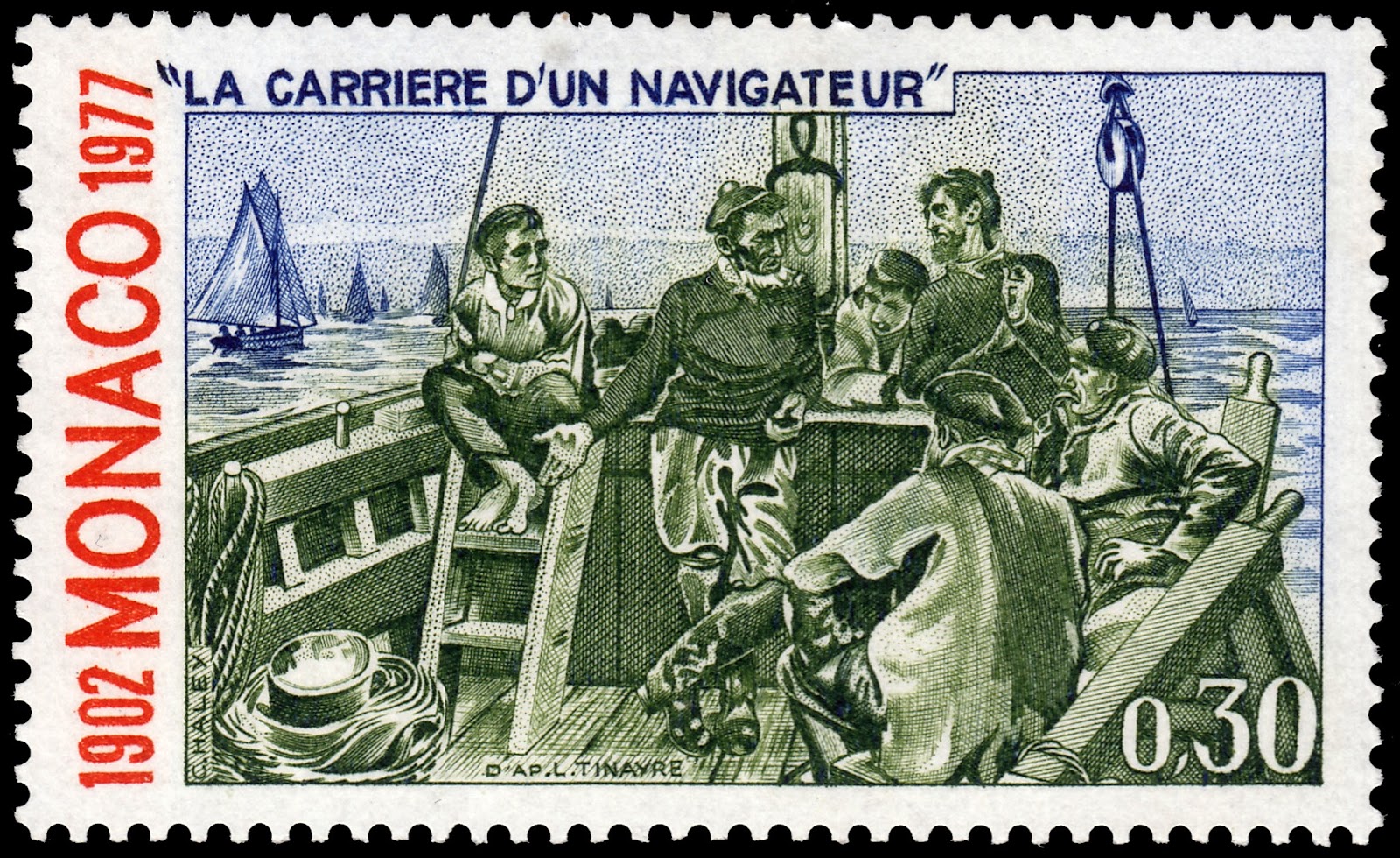
The 0,30f stamp was designed and engraved by Claude Haley. It features a lovely moment being shared by the crew members aboard one of Prince Albert I's research vessels.


***

The 0,80f stamp was designed and engraved by Michel Monvoisin. It features a splendid action shot of L'Hirondelle battling some rough weather. That wave in the background sure does look menacing!


Stay tuned for Part 2 of this gorgeous set next week!

Until then...

Friday, 8 July 2016

France 1974 - Medal of the French Resistance

The French Resistance played a vital role during World War II. Known in France as La Résis the Resistance organised themselves into small groups of armed men and women who worked against Nazi German occupation through various forms of guerrilla warfare and providing intelligence information for the allied forces. Additionally, the Resistance helped allied troops caught behind enemy lines providing them with possible escape routes. Perhaps one of the most important roles of the Resistance was to aid significantly the successful advance of allied troops through France after the Normandy invasion on 6 June 1944.

To honour the service of these brave men and women, the French Resistance medal, Médaille de la Résistance, was a decoration awarded to members of the Resistance. The award was established on 9 February 1943 to...
"...recognize the remarkable acts of faith and of courage that, in France, in the empire and abroad, (the Resistance) have contributed to the resistance of the French people against the enemy and against its accomplices since 18 June 1940".1
***

On 23 November 1974 France issued a set of three stamps commemorating the 30th anniversary of the liberation of France from the Nazis. One of these stamps features the French Resistance Medal. The stamp was designed and engraved by Claude Haley.


The design of this stamp is very evocative. On the left is a representation of French imprisonment under Nazi Germany. On the right a burning torch suggests of liberation from oppression. And in the centre of the stamp is a depiction of the French Resistance Medal.

References:

1. "History: Médaille de la Résistance", Chancellerie de l'Ordre de la Libération, 28 October 2006.

Until next time...

Sunday, 19 June 2016

France 1974 - TGV Turbo train

The TGV 001 (Train Grande Vitesse 001) was an experimental high-speed railway train built in France. This train was the very first TGV prototype. The prototype was commissioned in 1969, and testing of the train began in 1972.

The TGV 001 was part of a vast research program studying high speed rail technology. The program covered all technical aspects of the train, such as traction, behaviour of the vehicle on the tracks, braking, aerodynamics, and signalling. The initial plan was to construct two TGV's , but in the end only one was produced. According to Wikipedia, "The second was to be a tilting train equipped with an active tilting system, but was abandoned owing to technical difficulties".

The TGV 001 was unique, design-wise. It utilised an experimental gas turbine-electric locomotive. This system proved very effective. It managed to break the land speed record for a railed vehicle, achieving 318 kilometres per hour. It fact, it broke the 300 kilometre per hour barrier some 175 times! 


After the oil crisis of 1973, the cost of oil skyrocketed. This increase made gas-powered trains - like the TGV - no longer economically feasible. Testing on the TGV officially concluded on 19 July 1978.

***

On 2 September 1974, France issued a stamp commemorating the TGV 001 experimental train. The stamp was designed and engraved by Claude Haley. It was printed in Rotary Intaglio in three colours.


I'm not usually much of a fan of trains on stamps, but I really like the way Haley has conveyed a sense of speed in this image. The curved lines of air whoosing over the locomotive and the slightly blurred features on the nose of the train combine to create a sense of power and speed. Overall, a great design.

Until next time...