Showing posts with label *France. Show all posts

Tuesday, 25 June 2019

France 1979 - Tourism Series (Part 7)

It was the product of an inherited fortune. It employed an architect so obsessed with perfection, he razed whole sections of the building to the ground if they didn't meet with the approval  of his hyper-critical eye. From the time of its construction in 1630 till 1905 when it was purchased by the state, it passed through the hands of no less than seven different families. It was even visited by Louis XIV in April 1651.

***

The Château de Maisons, which is now called Château de Maisons-Laffitte, is located in Maisons-Laffitte, a northwestern suburb of Paris, in the department of Yvelines, Île-de-France. Construction of the château was commissioned in 1630 by René de Longueil using the funds from a fortune inherited by his wife, Madeleine Boulenc de Crévecœur, who died six years later in 1636, never to see the fruits of her inheritance. By 1651 the château was complete, and it was in this year that it played host to King Louis XIV in April.

The Château de Maisons was designed by François Mansart in the French baroque architectural style. According to a pamphlet entitled, La Mansarade, the architect realised, after completing the construction of the first floor of the château, that he had committed an error in the plans  So in a ludicrously egocentric move, he apparently razed everything built so far to the ground in order to start afresh! A tall tale? Who knows. But it certainly makes for a compelling story.

René de Longueil died in 1677, and the château remained in his family until 1732. Between that date and 1905 it passed through the hands of no less than seven families. Too many to list here. For a full history of the château, click HERE. In 1905, the State purchased the château in order to save it from demolition. Then in 1914 it was deemed an historical monument. 

***

On 9 July, 1979, France issued a set of seven stamps in their ongoing Tourism series. To read the previous six parts, simply click on the relevant link. Part 1. Part 2. Part 3. Part 4. Part 5. Part 6. In this blog I'll take a close look at the final stamp in this series, the 0,45 value. This stamp depicts the Château de Maisons, which is now called Château de Maisons-Laffitte. This stamp was designed and engraved by Pierre Forget. Contrary to the stamp depicting an architectural monument that I studied in Part 6, I think this one is a true stunner. A far  more interesting and visually appealing design than the stamp shown in Part 6. But that's just my humble opinion.


This stamp has, in my eyes, a somewhat Decaris-esque quality. If compared to Decaris' 1946 Luxembourg Palace design, we can see a marked similarity of line style.


***

Indeed, even the 1948 Saarland architectural stamp by Decaris bears some similarity, I feel.


Until next time...


Friday, 21 June 2019

France 1979 - Tourism Series (Part 6)

For several centuries it was considered one of the richest, if not the richest, of Abbeys in France. It was the hub of intellectual life in the French Catholic church, housing one of the most important scriptoriums in the country. It was pillaged and burned by Vikings, then like a phoenix rising from the ashes, it  was restored to its former glory only to have portions blow up, towers collapse and other forms of atrocious wonders. This is the Benedictine Abbey of Saint-Germain-des-Prés in Paris.

***

Founded in the 6th Century by Childebert I, who was the son of Clovis I, the Abbey of Saint-Germain-des-Prés was built on the outskirts of early medieval Paris, in a region of the Left Bank that was quite prone to flooding from the Seine. Consequently, it was established on slightly raised meadow land, known in French as a prés. Hence the name it has been given. By the 9th Century it was already considered one of the richest abbeys in France, as evidenced by its polyptych (an inventory of properties owned by the church). It was also in this century that  it was the victim of several Viking onslaughts, which left parts of the church grounds little more than smoking ruins. By 1014 it had risen from the ashes and was restored to something akin to is former glory, possibly even more glorious. 

Over the course of the next two centuries, its riches and stature grew, and by the 11th Century, the church contained what was considered an "important" scriptorium, a polite way of saying a kick butt library! In fact, the abbey was the hub of the Catholic church's intelligentsia right up until the French Revolution when it was disbanded. But this wasn't the end of the destruction inflicted upon the abbey. In 1794 a fire broke out completely destroying its library. And at some point (I'm assuming around this time but haven't been able to find a date yet) an explosion of stored saltpeter totally levelled the abbey and its cloisters. Only the church itself was spared in this particular disaster. To this day the abbey church remains as the Église de Saint-Germain-des-Prés. It is one of the oldest, and perhaps one of the most unlucky, churches in Paris.

***

On 9 July, 1979, France issued a set of seven stamps in their ongoing Tourism series. To read the previous five parts, simply click on the relevant link. Part 1. Part 2. Part 3. Part 4. Part 5. In this blog I'll take a close look at the 1,40 stamp, which depicts the Abbey of Saint-Germain-des-Prés. This stamp was designed and engraved by Jacques Gauthier. This stamp has been executed in a 2D front elevation style akin to an architectural drawing. Personally, I'm not very partial to this design. For an abbey with such a remarkable history, I would have thought a stamp with a far more dynamic representation of the building was in order. I'm sure there are those out there that love its detailed simplicity. And that's totally fine. But I don't. I consider it rather boring. 


Until next time...


Thursday, 13 June 2019

France 1979 - Tourism Series (Part 3)

An absurd undertaking can be viewed as 'tilting at a windmill', but for practical purposes, windmills have been an efficient way of generating power since they first appeared in Persia in the 9th Century. Windmills have been used to pump water, mill grain, or as we shall soon see, to pump oil.

Somain is a commune in the Nord department in northern France. It is primarily known for its extensive mining industry. Its first mine, called the Renaissance mine, opened in 1839. Somain was also the home to a large windmill that was built in 1744. In 1901, the windmill was moved to its present location in Steenvoorde, a short distance south of Dunkirk. The mill was later restored (I've been unable to find a restoration date), and it is being used as an oil mill. 

***

On 9 July, 1979, France issued a set of seven stamps in their ongoing Tourism series. To read the previous two parts, simply click on the relevant link. Part 1. Part 2 In this blog I'll take a close look at the 1,20 stamp, which depicts the Steenvorde windmill.. This stamp was designed and engraved by Eugène Lacaque. 


Based on photos I've seen of the restored windmill, it seems to me that this design features a fairly rundown windmill, crying out for assistance. It is clearly evident the the sails (or blades) are in a pretty sad state of disrepair. However, there is the chance that this is simply how Lacaque chose to engrave the sails. I lean toward the former.

Until next time...


France 1979 - Tourism Series (Part 2)

It started life as a grand palace in 1309, it saw a mighty clash of religious leaders in 1415, and in 1502 it was besieged, resulting in a portion of its structure being destroyed. This is the intriguing life of the Palace of the Kings of Majorca.

***

In 1276, King James II of Majorca decide to make Perpignan the capital of the his Kingdom of Majorca. Enlisting architects Ramon Pau, Pons Descoll, and Bernat Quer, he set about planning the construction of the palace on the hill of Puig del Rey. It was to be constructed in the Gothic style, surrounded by sprawling gardens. The palace was completed 35 years later in 1309.

A little over 100 years later in 1415, the Holy Roman Emperor, Sigismund of Luxemburg, arranged for a summit to be held in the palace. The purpose of the gathering was an attempt to coax the Avignon Antipope Benedict XIII to resign his office and hopefully bring an end to the Western Schism (a split within the Catholic church, from 1378 to 1417). This proved a futile gesture, and after a verbal clash with the Antipope, the Roman Emperor left Perpignan on 5 November, presumably with copious quantities of steam pouring from his ears!

Then a little less than 100 years after the epic debate, the palace was the unfortunate host of a siege in 1502. This siege resulted in the destruction of a part of the northern wing. Fast forward a little over 150 years to 1659. Following the Treaty of the Pyrenees in 1659, many of the defensive features of the palace were added. 

If we skip forward a further 300 years to 1958. In this year, the palace and its magnificent gardens was purchased by the General Council of the Pyrénées-Orientales. Since then it has been home to the French Ministry of Defence, a rather fitting use.

***

On 9 July, 1979, France issued a set of seven stamps in their ongoing Tourism series. To read Part 1, click HERE In this blog I'll take a close look at the 1,70 stamp, which showcases the Palace of the Kings of Majorica. This lovely stamp was designed and engraved by René Quillivic. 


Admittedly, this stamp is predominately walls. But I feel it showcases the differing roles of the palace over the centuries with an almost brutal efficiency. I quite like it.

Until next time...


Wednesday, 12 June 2019

France 1979 - Tourism Series (Part 1)

He raised the torch high, the firelight casting dancing demon-shadows across the irregular cave walls. He ran a calloused hand with delicate precision across the rough surface. A smile creased his face. Yes, yes. This spot would do very nicely. He set down the torch, stepped up to the rocky canvas, and began working in earnest.

***

It almost defies the imagination to think that a moment of artist inspiration, somewhat loosely akin to the fictional account above, occurred in a cave in south-western France some 13,000 years ago and evidence of said event still exists today. In fact, the Cave of Niaux, Grotte de Niaux, is home to numerous galleries containing beautifully-rendered wall paintings. Archaeologists date the site to the Magdalenian period between 17,000 and 11,000 years ago. The artwork found in these cave galleries is typical of the style prevalent in the Magdalenian Period, called simply black-outlined style. One of the most well-known paintings is located in The Black Hall, Le Salon Noir
The predominating animal is the bison, represented in the upper part of the panel. The bison standing out in the left central part is usually catalogued as a female, due to the shapes presented, such as the scarcely prominent hump. By contrast and in opposition to this is the male, found on the right-hand side and showing a more prominent hump.
The lower part of the wall represents several horses which, with painted hair, represent a member of the equine family with a great amount of hair, the Przewalski. The bestiary is finished off with two goats, one represented in a very natural manner and the other in a totally schematic manner. The panel is dated as being 13,000 years old. (Wikipedia)
***

On 9 July, 1979, France issued a set of seven stamps in their ongoing Tourism series. In order to focus better on each stamp in this series, I will do a separate blog post for each. In this blog I'll take a close look at the 1,50 stamp, depicting artwork from the Cave of Niaux. This gorgeous stamp was designed and engraved by Marie-Noelle Goffin. 


Marie-Noelle Goffin has done a splendid job, reinvigorating this artwork and rendering it in stamp form for the world to share. Dominating the centre left of the stamp is a majestic bison, which as mentioned in the quote above, has been deemed by experts as a female due to that fact that it is depicted as possessing a small hump. 


***

The bison to the right is considered a male, due to its large hump. 


***

Elsewhere on the painting, we see a goat (bottom left) and a female horse (bottom right). 


***

This painting is a fasicnating snapshot into the paleo-world of France c. 13,000 years ago.

Until next time... 


Monday, 16 April 2018

France 1951 - Modern Poets (Part 3)

"I'm now making myself as scummy as I can. Why? I want to be a poet, and I'm working at turning myself into a seer. You won't understand any of this, and I'm almost incapable of explaining it to you. The idea is to reach the unknown by the derangement of all the senses. It involves enormous suffering, but one must be strong and be a born poet. It's really not my fault." (Jean Nicolas Arthur Rimbaud, 1871. Wikipedia)
Some people turn to writing and expressing their deepest emotions with the power of words later in life, their copious experiences their thesaurus. In others, the spark is lit early in life, burns bright, then is snuffed out. 

Jean Nicolas Arthur Rimbaud, born 20 October 1854, started writing from a very young age, and it was quickly obvious he was a gifted poet. He was an excellent student, but perhaps stymied in the world of academia, he ran away to Paris as a teenager during the Franco-Prussian War. It was during this time that the words poured from his soul and he wrote many works of poetry, a lot of which was assembled in the book titled, Illuminations. Then inextricably, he completely stopped writing at the age of 21. He spent the rest of his brief life exploring several continents as a merchant. Tragically, he died of cancer just after his 37th birthday on 10 November 1891.   .

Rimbaud was known as quite a restless soul who loved hard and played harder. In 1871 Rimbaud had a torrid love affair with fellow poet Paul Verlaine (see Part 2 of this series for information on Verlaine). The next few years was a wild ride for the pair, spiced with absinthe, opium and hashish. Yet during this time Rimbaud still churned out the poetry, including one of his major works, A Season in Hell. Rimbaud is best known for his work with Symbolism and helping to ignite the flame of Surrealism. 

***

On 27 October 1951, France issued a set of three stamps celebrating modern French poets. The 15f value of the set depicts Jean Nicolas Arthur Rimbaud. This stamp was designed by Paul-Pierre Lemagny and engraved by Gabriel-Antoine Barlangue. It is worth mentioning that the portrait of Rimbaud used in this stamp was based on a portrait by Henri Fantin Latour.. 


The turbulent nature of this composition seems to mirror the wild life of Rimbaud. In the foreground we are faced with a youthful Rimbaud. His sits pensive, with hand on chin, perhaps ruminating over his next masterpiece. At the back left of the composition waterspouts (tornadoes on land) abound. Adrift in the churning maelstrom, a direct reflection of the poet's life, is a hapless ship, adrift, in dire need of respite. Behind the poet's shoulder to the right we see towering, snow-capped mountains and some butterfly-like creatures gamboling to some poetic tune only they can hear. In conclusion, what an awesome stamp!

Until next time...


Friday, 19 January 2018

France 1936 - Louis Blériot

What do truck headlights and astounding feats of aviation have in common? Louis Blériot, aviator, inventor, and engineer.

***

Louis Blériot, born 1 July 1872 in Cambrai, France, was drawn to engineering and design from at young age. Indeed, while attending the Institut Notre Dame in Cambrai, he won many class prizes for his engineering drawings. He then attended the prestigious École Centrale in Paris, after having spent a year gaining special tuition in order to pass the rigorous entrance exam. He graduated École Centrale around the middle of his class, which considering the high level of competition was a pretty decent result.

His first job was at an electrical engineering company in Paris, called Baguès. It was during this time that he came up with an invention, which would eventually bankroll his other passion, aviation. He designed and created the first ever practical headlamp (headlight) for automobiles. His new headlamp used a compact integral acetylene generator. In 1897, he decided to leave the company he had been working for and opened his own showroom in Paris, selling his headlamps. Turns out, this was an excellent business decision, for he quickly gained contracts with two of the foremost automobile manufacturers of the time, Renault and Panhard-Levassor.

Ever since his school days, Blériot had had an interest in aviation, but it wasn't until his visit to the 1900 Exposition Uniiverselle that he thought seriously about aircraft experimentation. It was seeing Clément Ader's Avion III, an experimental steam-powered aircraft, that seemed to really get his creative juices flowing. I can understand why. This 'plane' must have, at the time, seemed quite extraordinary. Check the Avion III out HERE

As I mentioned earlier, Blériot's headlamp business was going great guns so he could afford to splash about a bit of cash with some aviation experiments of his own. His initial experiments were with ornithopters, which are craft propelled by flapping wings, in the fashion of a bird. Many of these were powered by men with the wings strapped to their arms. Then they set about flapping like crazy in an attempt to achieve flight. Ornithopters have always been a bit hit and miss, and Blériot's attempts fell into the 'miss' column.

Then in 1905, he met a fellow aviation enthusiast, a man who would also later become his business partner, Gabriel Voisin. At the time Voisin was working for a fellow named, Ernest Archdeacon, on experimental gliders. Blériot, also an avid photographer, filmed Voisin the during the trials of a floatplane glider Voisin had built. Witnessing this event sparked Blériot into commissioning Voisin to build a similar plane for him. This plane, another glider, was called the Blériot II. Although this plane crashed and Voisin, who was flying it, nearly drowned, the two men were not deterred. Indeed, they soon established their own company, Ateliers d' Aviation Edouard Surcouf, Blériot et Voisin.

The partnership lasted until the end of 1906. During which time the pair built the Blériot III and IV, two powered aircraft that both proved unsuccessful. Their lack of success coupled with the success of rival aviator of Alberto Santos Dumont, who flew his 14-bis a distance of 220 m (720 ft), winning the Aéro Club de France prize for the first flight of over 100 metres, saw the dissolution of the pafrtnership.

After the partnership with Voisin, Louis Blériot established his own business, Recherches Aéronautiques Louis Blériot, This business was primarily funded by Blériot, who employed his own engineers and designers. Over the next couple of years Blériot developed a whole series of aircraft, bearing his name, each one slightly better than the rest. This aircraft research culminated in the construction of the Blériot XI.

At 4:41 am on the 25 July 1909 Blériot made history in his Type XI by setting off from Calais, France in an attempt to cross the English Channel. "Flying at approximately 45 mph (72 km/h) and an altitude of about 250 ft (76 m), he set off across the Channel. Not having a compass, Blériot took his course from the Escopette, which was heading for Dover, but he soon overtook the ship." (Wikipedia)

During the crossing, visibility rapidly deteriorated. In fact, Blériot later said, “for more than 10 minutes I was alone, isolated, lost in the midst of the immense sea, and I did not see anything on the horizon or a single ship”.

Thankfully, a short time later, Blériot spotted the English coast. Unfortunately for Blériot, he had not previously visited Dover to find a good spot to land, so he had to wing it. After spotting Charles Fontaine, the correspondent from Le Matin waving a large Tricolour as a signal, Blériot "circled twice to lose height, and cut his engine at an altitude of about 20 m (66 ft), making a heavy 'pancake' landing due to the gusty wind conditions; the undercarriage was damaged and one blade of the propeller was shattered, but Blériot was unhurt. The flight had taken 36 minutes and 30 seconds." (Wikipedia) Thus history was made!

***

On 21 November 1934, France issued a stamp celebrating the 25th anniversary of Louis Blériot's English Channel crossing. The stamp was designed and engraved by Achille Ouvré. It is a stunning design featuring a map of the English Channel overlaid by Blériot's Type XI aircraft.


Until next time...


Friday, 3 November 2017

France 1934 - Jacques Cartier

French explorer Jacques Cartier has become famous for his explorations along the St. Lawrence River, and also for giving Canada its name. Born 31 December, 1491, in Saint-Malo, Brittany, France, with the heart of an adventurer, Jacques Cartier came to the attention of King Francis I of France in 1534. It was after this first meeting that Cartier's name was destined for the record books.

The King, impressed by his already strong skills as a mariner, commissioned Cartier to embark on a voyage to the eastern coast of North America, to an area then called the "northern lands". This was the first of three voyages Cartier would take across the Atlantic for his king. Cartier was given command of two ships and 61 men for the journey. His mandate: to search for gold, spices, and a passage to Asia. The small fleet set sail on 20 April 1534, arriving on the west coast of Newfoundland 20 days later. On this first voyage, Cartier discovered Prince Edward Island and sailed through the Gulf of St. Lawrence, past Anticosti Island. But alas, no gold or passage to Asia was found. Nonetheless, when he returned to France, King Francis was so impressed by his report that he decided to send Cartier on a second trip, scheduled for the following year.

In May 1535, Cartier set sail again for North America. This time round his fleet consisted three ships with 110 men, including two Indians Cartier had captured previously (perhaps his last voyage). The two Indians were taken to serve as guides. On this journey Cartier navigated his way down the St. Lawrence river, as far as Quebec, where he established a base. There he remained until September when he decided to push further downriver to what would become Montreal, the promise of all that wealth setting his blood aflame. In the Montreal area he stumbled across the Iroquoi, who lived in that region. They welcomed him and his men, and went on to tell him that there were other rivers that led farther west, where gold, silver, copper and spices could be found. This was exactly what Cartier had been yearning to hear! But before they could continue any further downriver, winter came. The river morphed into angry rapids, rendering it impassable. Additionally, it is said that Cartier and his men somehow angered the Iroquois during this visit. Cartier was forced to wait until spring, however, for the ice to melt. But as soon as the ice was gone, he beat a hasty retreat back to France, taking with him some of the Iroquois chiefs he had met and captured. This was not the wisest diplomatic move! Upon his return, Cartier could only report to the king that he had been told that untold riches lay farther west. And also that a large river, said to be about 2,000 miles long, possibly led to Asia. This information seemed to be enough to convince King Francis to fund a third voyage west. A voyage that proved to be Cartier's last.

Six years later Cartier left for the west for the last time with a fleet of five ships. This time, however, his mandate had changed. The idea of finding a passage to Asia had now been abandoned. His mission this time was to establish a permanent settlement "along the St. Lawrence River on behalf of France" (Wiki). A few months after he left, a group of colonists were sent in his wake. On arrival, Cartier again set up his base at Quebec. While waiting for the colonists, they explored the area and happened upon what they thought to be an abundance of gold and diamonds. Cartier must've thought all his Christmas' had come at once! Here before him was the mother-lode he'd been dreaming about. having discovered what he conceived to be his ticket to untold wealth, Cartier abandoned the base and made a bee-line back to France. Unfortunately on his way back, at a stopover in Newfoundland, he happened across the colonist fleet. The leader of the fleet was disgusted with Cartier and ordered him back to Quebec. But Cartier had other ideas. There was no way he was going to jeopardise his dreams of being filthy rich and the envy of all society. He thus ignored the leader of the colonists, and that night, under the cover of darkness, sailed for France, his riches safely in his grasp.

As is often the case with grandiose thoughts, Cartier's dream was nothing more than an illusion. In a twist of tragedy, fit for the pages of a Greek play, Cartier returned to France to discover his precious gold and diamonds were completely worthless! This was the sad conclusion to Cartier's state-funded explorations. He eventually retired from the spotlight with a career tarnished by his shady dealings with the Iroquoi and abandoning the colony in Quebec (the colonists actually abandoned the settlement a year later after only just surviving a bitter winter). As an interesting footnote to this story, France didn't return to Canada for a half a century.

***

On 20 July 1934 France issued a set of two stamps commemorating the 400th anniversary of Jacques Cartier's first voyage to Canada. The set consisted one design issued in two values, drawn and engraved by Achille Ouvré from a portrait by Canadian painter, Théophile Hamel (1817-1870), of François Riss (since a portrait of Cartier himself doesn't exist). There are some who believe Pierre Gandon's statement that Ouvré used him as the model for his portrait of Cartier. But this I will leave for a future blog. For now let's simply take a look at Ouvré's beautiful design!


***

Incidentally, this design is one of many featuring the explorer, Jacques Cartier. One of my favourites is a stamp issued in Canada on 1 July 1934.


Until next time...


Thursday, 5 October 2017

France 1934 - Jacquard

Computers, tablets, smartphones, and all that other technology we rely on and take for granted these days, may not have even existed without the pioneering efforts of people such as Joseph Marie Charles, nicknamed Jacquard. And yet before a couple of days ago I will freely admit I'd never heard of the man. So who is he?

Jacquard, born 7 July 1752, was a French weaver and merchant, and perhaps most importantly, somewhat of a mechanical genius. Jacquard's father was a master weaver and property owner, so the family had a decent amount of money, yet Jacquard had no formal schooling. In fact, he was illiterate until the age of 13 when his brother-in-law, Jean-Marie Barrett, who ran a printing and book selling business, started teaching him. Barrett also introduced him to the world of scholars and high society. It is thought that initially Jacquard worked for his father, assisting him in the operation of his loom. Jacquard didn't particularly like the physical nature of the work, so he tried his hand at bookbinding and then with a maker of printers' type, an occupation known as a type-founder.

In 1772 his father died, leaving him a substantial inheritance including his house, looms, and workshop, as well as a vineyard and quarry in Couzon-au-Mont d’Or. It seems, however, that Jacquard was not much of a businessman, since there is evidence to suggest he ran up a substantial debt and lost all of his father's estate. Fortunately, his wife's dowry was substantial and included her own house, in which they were able to live.

By 1800 Jacquard was working as an inventor. It was in this capacity that he did his best work. In that very year, he invented a treadle loom. Then in 1803, a loom to weave fishing nets. But it was in 1804 that he came up with his best creation yet, a machine that became known as the “Jacquard” loom. This loom was designed to weave patterned silk automatically. The loom worked by using "pasteboard cards with punched holes, each card corresponding to one row of the design. Multiple rows of holes are punched in the cards and the many cards that compose the design of the textile are strung together in order" (Wikipedia). This early form of programmable machine played an important role in the development of other programmable machines, such as an early version of digital compiler used by IBM to develop the modern day computer. After some teething problems, the Jacquard loom took off. By 1812 there were 11,000 Jacquard looms in use in France. Jacquard died on 7 August 1834 in Oullins, a suburb in the city of Lyon, France.

***

On 19 March 1934, France issued a stamp for the 100th anniversary of the death of Joseph Marie Charles, honouring his contribution to industry. The stamp was designed and engraved by Achille Ouvre based on an artwork by Claude Bonnefond. Incidentally, this was the first small format stamp printed in intaglio issued by France. The source from which I got this information doesn't specify if it was the "world's first" or "France's first" small format intaglio issue. Anyway, to the stamp. It is a beauty. It also happens to be Achille Ouvre's first engraved stamp.


I have only just started studying the work of Ouvre, and I have to say I love what I have seen so far. I look forward to showcasing more of his stamps in the future...

Until next time...


Monday, 2 October 2017

France 1957 - Europa

Way back in 1956 a decision was made to create a common design stamp issue for the European community. The idea was not only to promote the rewarding pursuit of philately, but also to educate people in the history of Europe and the common roots that Europeans share. Thus the EUROPA stamp issue was born. Initially, there were six participating countries: Belgium, France, Germany, Italy, Luxembourg, and Netherlands. All participating countries issued stamps of the same design to be produced in their own countries, using their own printing techniques and engravers when applicable. The common design chosen for the first EUROPA issue was a tower in the form of the 6 letters of the word EUROPA. The design was created by Frenchman Daniel Gonzagu. France's first EUROPA stamps were issued in two values, and the 'common' design was engraved by Jules Piel. 


In 1957 EUROPA allowed participating countries to issue stamps based on the common "theme" instead of a common design. The theme was Peace and Welfare through Agriculture and Industry. This idea of providing the participating countries with just a theme gave individual designers freedom to come up with their own artistic interpretation of the theme. Incidentally, the number of participating countries had now risen to eight to include Saarland and Switzerland.

***

On 16 September 1957, France issued its EUROPA design, printed in two values. The issue was designed and engraved by Albert Decaris. Decaris has brilliantly captured the essence of the theme in his design. It features two hands. One hand is holding an olive branch and wheat, symbolising peace and prosperity through agriculture. The other hand holds a large gear, through which another olive branch is entwined. Machinery and nature are here almost one with each other in a symbiotic relationship.


Until next time...


Wednesday, 27 September 2017

France 1956 - Benjamin Franklin

To say he was a man of many talents would be a massive understatement. He was the very definition of the title "polymath". Inventor, scientist, politician, printer, and diplomat to name but a few of his pastimes. The man, if you haven't already guessed, is Benjamin Franklin. 

To write an in-depth biography of Benjamin Franklin I'd need far more space than I usually allow for a blog - probably need a rather large book actually! So what I'll do here is try to concentrate on some of the more uncommon things about Benjamin Franklin. First off let's quickly get acquainted with Benjamin Franklin. He was born in Boston, Massachusetts on January 17 1706. His father, Josiah Franklin, was a soap and candle maker. Josiah had two wives, fathering seven children with the first, and a staggering ten with the second wife! Ben was the fifteenth child. Ben started out working in his father's shop, but melting wax all day wasn't for him. He then tried his hand at the printing business under the tyrannical rule of his brother. He hated working for his brother, so he struck out on his own by moving to Philadelphia. From here his career thrived.

Now to some things about this great man that I personally didn't know.  Ben Franklin is rather famous for his inventions such as bifocal glasses and the lightning rod. But I did not know that he also invented the flexible urinary catheter. I also didn't know that he never chose to patent any of his inventions, believing that they should be freely accessible to all.

Franklin also revitalized the idea of Paying it Forward. This is the concept of doing a good deed of some kind to a person and instead of the person paying you back they in turn do a good deed for someone else. An excellent practice in my opinion. This idea was first introduced as a key plot in Menander's play Dyskolos (The Grouch) which was performed in Athens in 317 BC. In a letter to Benjamin Webb dated 25 February 1874 Ben Franklin suggests the use of such a concept.

Another interesting tidbit I just read about. Ben was a very accomplished chess player, and his travels in Britain and France gave him the opportunity to duke it out with some of the greatest chess minds of the time.. When in Paris, both as a visitor and later as ambassador, he visited the famous Café de la Régence, which France's strongest players made their regular meeting place. Unfortunately, no records of his games have survived, so it is not possible to ascertain his playing strength in modern terms.

I also didn't realize Ben Franklin was the first Postmaster General of the United States. And interestingly, aside from George Washington,  Ben Franklin appears on US postage stamps more than any other famous person. He first appeared on a US postage stamp in 1847. 


Benjamin Franklin also appeared on the famous long-running Washington-Franklin series from 1908 to 1923. And many more issues, but amazingly on only a few commemorative issues. One commemorative issue he did appear on was engraved by perhaps the best stamp engraver in the world, Czeslaw Slania. This stamp issued in 1983 was a joint issue with Sweden.


He died on April 17 1790 in Philadelphia, Pennsylvania at the ripe old age of 84. 

***

On 12 November 1956 France issued a set of six stamps featuring famous foreigners who worked in France. One of the stamps features Benjamin Franklin, who, as mentioned above, worked as a ambassador in France. The stamp was designed and engraved by Albert Decaris. In this design, Decaris captures the witty and playful nature of Franklin not seen in a lot of his portraits. I like this stamp. It was fun and quirky.


Until next time...


Thursday, 21 September 2017

France 1956 - Samuel de Champlain

His skills and accomplishments were numerous. Among other things, he was a navigator, cartographer, draftsman, soldier, and explorer. He was instrumental in the founding of Quebec City. And he was later dubbed "The Father of New France". So who is this rather remarkable fellow? We are, of course, talking about none other than Samuel de Champlain.

Samuel de Champlain was born in Brouage, France. There is some contention as to the actual date of his birth. Some say as early as 1567. Other theories include dates up to and including 1575. Scholarship is now fairly certain he was born on or before 13 August 1574. Whatever the year of his birth was, we do know that he began his life as an explorer and seaman in 1598 when he travelled on the ship Saint-Julien with his uncle-in-law. The ship had been commissioned to carry Spanish troops to  Cádiz. During the journey, which was apparently long and hard (over two years) Champlain was given the opportunity to "watch after the ship". This was an excellent opportunity for him to learn the art of seamanship - to "learn the ropes" as it were. And Champlain also took the opportunity to hone his burgeoning writing and cartography skills. He wrote detailed notes of his journey, including illustrations. So good was the work that upon return to France, King Henry IV rewarded Champlain with an annual pension. Then when his uncle died in 1601, he left Champlain his considerable estate along with a merchant ship. His future as an explorer was set.

In 1603 he made his first voyage to North America as an observer on a fur trading expedition. Making the trek across the Atlantic and exploring parts of North America became second nature to Champlain. Indeed, in 1604 and again in 1605 he was back over there, exploring the eastern coastline as far south as Cape Cod.

But it was in 1608 that Champlain would forever cement himself in the annals of history. Sent back across the Atlantic at the command of a fleet of three ships to find a suitable spot for a colony on the St Lawrence River, he came across a nice spot which he would name "Quebec", which comes from the Algonquin word kébec meaning "where the river narrows". This was the origin of Quebec City. The first settlement consisted of three buildings, a stockade, and a moat, which Champlain called the "Habitation". The Habitation became Champlain's lifelong passion. He even built himself a large dwelling he called Fort Saint Louis.

Throughout his life, Champlain also settled the area that became the city of Montreal, and he made detailed maps of the Atlantic coast and the Great Lakes. By 1620 he had settled into an administrative role as the de facto governor of New France from a command post in Quebec. Samuel de Champlain died on December 25, 1635, in Quebec.

***

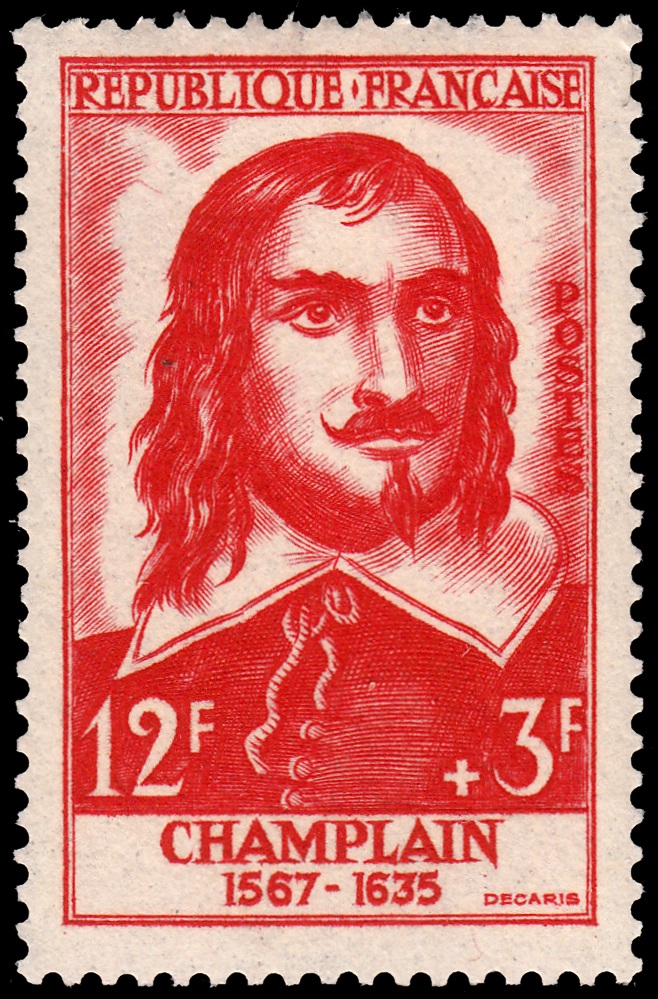
On 11 June 1956 France issued a set of six stamps honouring famous French people. One of the stamps features Samuel de Champlain. The stamp was designed and engraved by Albert Decaris. The stamp is a semi-postal with a face value of 12f with a 3f surcharge for the benefit of the Red Cross. When I first saw this stamp I wasn't really all that enamoured by it. But over time I have come to like it. The strong bold lines and the penetrating eyes of the explorer, the eyes of a visionary. And of course I love the beard!


I'd like to end this blog with a nice little quote by Champlain himself:
“The advice I give to all adventurers is to seek a place where they may sleep in safety.”
—Samuel de Champlain
Until next time...


Saturday, 16 September 2017

France 1956 - Marshal Franchet of Esperey

Considered by some as the personification of a howitzer shell with the steely disposition of a tyrant, Louis Félix Marie François Franchet d'Espèrey, was a French General during World War I. Yet outside his tough military demeanor, d'Espèrey was a kind man with, as we shall see, the heart of an adventurer.

D'Espèrey, born 25 May 1856 in Mostaganem in French Algeria, was the son of a cavalry officer in the Chasseurs d'Afrique. Following in his father's footsteps, d'Espèrey began his life-long military career in 1876 after being educated at Saint-Cyr. Before the outbreak of World War I, d'Espèrey had already forged a distinguished career. After serving in a regiment of Algerian Tirailleurs (native infantry), he served in French Indochina, and then in China during the Boxer Rebellion in 1900. He was then packed off to France where he was given command of various infantry regiments in France. He obviously did something right, as in 1913 - just a year before the war - he was given command of I Corps.

During WWI, d'Espèrey served on several fronts. Most notably, he was given command of the large Allied army based at Salonika. It was in this role that he led "the successful Macedonian campaign, which caused the collapse of the Southern Front and contributed to the armistice" (Wikipedia). After the war his military successes continued with the command of operations against the Hungarian Soviet Republic in 1919. Then on 19 February 1921 he was given the honour of the title of Marshal of France.

Skipping ahead to 1924, we find d'Espèrey now in the role of inspector-general of France's North African troops. It was in this capacity that he "became interested in the strategic potential of the "grand axis" north-south route across the Sahara" (Wikipedia). And it was later in this same year that the adventurous spirit within d'Espèrey was unleashed.

On 15 November 1924, d'Espèrey joined a trans-Saharan expedition led by Gaston Gradis in three six-wheel Renaults with double tyres (see image below). Interestingly, this was Gradis' second trans-Sahara expedition, the first being earlier in that same year. Other members of the expedition included the journalist Henri de Kérillis, commandant Ihler, the brothers Georges Estienne and René Estienne, three Renault mechanics and three legionnaires. Overall the expedition travelled 3,600 km of rugged terrain to reach Savé in Dahomey on 3 December 1924. One can only imagine the stories of the adventures these intrepid explorers had to tell. Any one of them would have certainly made an entertaining dinner guest!


***

On 28 May 1956 France issued a stamp commemorating the 100th anniversary of the birth of Marshal Franchet d'Espèrey. The stamp was designed and engraved by Albert Decaris. In this design Decaris manages to capture the fierce pride and determination of a great French leader with the heart of an adventurer. It is also worth noting that Decaris has discreetly incorporated one of France's defining landmarks, the Cathedral of Notre Dame. Can you find it?


Until next time...


Thursday, 10 August 2017

France 1956 - Battle of Verdun

Human history has been witness to some of the most brutal acts of violence. Violence on a scale incomprehensible to imagine. Perhaps one of the most blood-soaked periods of our history was World War I, a war that claimed over 41 million souls. Staggering! And the worst of the battles in this time of mass slaughter was the Battle of Verdun.

World War I was the embodiment of a new age of warfare. New weapons of war such as the howitzer, the mightiest of these being Big Bertha, which could reign destruction on a enemy target up to 9 km away. It was also the dawn of the flying aces of aerial warfare. Who hasn't heard of the legendary Red Baron? Destruction also now came from underwater in the form of submarines, such as the classic German U-boats. And although chemical warfare had been around for a very long time, World War I saw the first mass use of such diabolical weaponry. Chemical agents such as tear gas, and more lethal agents like phosgene, chlorine, and mustard gas were being employed in an attempt to smoke enemies from entrenched areas.

Which leads us to the birth of an horrendous age, the age of Trench Warfare. The most famous arena for Trench Warfare in World War I was the Western Front, a vast area of land riddled with complex networks of trenches, an area where millions of French and Germany soldiers died for little or no gain in territory. Soldiers lived in appalling conditions, before, like lambs to the slaughter, they went 'over the top' of the trench to be mowed down by enemy artillery. It was a ludicrous method of warfare where soldiers died seemingly at the whim of their commanding officers, who, for want of anything better to do, ordered charge after charge. The British public referred to their soldiers as "lions led by donkeys". Indeed, on the first day of the Battle of the Somme, the British lost 60,000 men - a death toll difficult to comprehend.

The longest battle in the trenches was the Battle of Verdun from 21 February to 18 December 1916. I shall not belittle the sheer horror and complexity of this battle by trying to summarise it here. Instead, I will throw a few statistics your way. The Battle of Verdun was fought between French and German soldiers. It raged for 303 brutal days, and is considered one of the most costly battles in human history. It is currently believed that the total number of casualties in the battle amounted to 714,231. 377,231 of these were French and 337,000 German. Averaging out these staggering numbers we get roughly 70,000 casualties a month or over 2,300 a day! I can't even begin to imagine! For an in-depth analysis of the battle click HERE

***

On 5 March 1956 France issued a stamp commemorating the 40th Anniversary of the Battle of Verdun. Albert Decaris was given the honour of designing and engraving this important stamp. I think he did a beautiful job with this difficult task.


***

Over time, quite naturally, French Post have issued stamps commemorating this battle, all of which have been beautifully rendered. In fact, I believe there to be an interesting blog on that subject on the horizon. But for now, take a look at this page to peruse more Battle of Verdun stamps, click HERE

Until next time...


Friday, 4 August 2017

France 1961 - Aristide Maillol

A master tapestry designer, painter, and sculptor, Aristide Maillol was a man of many talents. Born 8 December 1861 in Banyuls-sur-Mer, Roussillon, France, Malliol apparently aspired from a young age to be a painter. In 1881 at the age of 20 he moved to Paris to study at the École des Beaux-Arts. Unfortunately things didn't work out as well as he had hoped. He applied to the art school several times and received rejection after rejection. By the time the school finally did accept his application in 1885, Malliol had been living for some time in poverty. I've been unable to find anything about he his studies went, but it would probably not be a stretch to say he did very well.

Mallol's early paintings were heavily influenced by contemporary greats Pierre Puvis de Chavannes and Paul Gauguin. In fact, Gauguin took an interest in Malliol's work, particularly his decorative art. Gauguin was so impressed that he encouraged Malliol in this direction, which led him to try his hand at tapestry design. Malliol excelled in this art form, and even opened his own tapestry workshop. Malliol gained critical acclaim for the work produced in his workshop. His work sparked a new wave of interest for tapestry design in France. 

But Malliol was keen to broaden his artistic horizons by experimenting in other mediums. In 1895 he began making sculptures in terracotta. Within a few short years Malliol was totally hooked on the art of sculpture. So much so that he completely abandoned his work with tapestry art. Indeed, Malliol is now probably most remembered by his beautiful sculptures celebrating the nude female form. One such sculpture was titled Woman aka The Mediterranean circa 1905. 


***

On 20 February 1961 France issued a stamp celebrating the work of Aristide Malliol. The stamp was issued just under one hundred years after his birth. It was designed and engraved by Albert Decaris. The subject of the stamp was the statue The Mediterranean as mentioned above.


I find this piece of work fascinating. It is the work of one artist, Albert Decaris, utilising his own artistic style to replicate a famous sculpture. I know what your probably saying: stamp engravers have reproduced thousands of pieces of art! That is very true. But within this stamp in particular I can discern the caricature-like style of Decaris blended with the unique talents of Malliol. An impressive piece of stamp art indeed!

Until next time... 


Tuesday, 25 July 2017

I Study... Aspects of an Airmail Design

Sometimes it is difficult admire the beauty of a lone tree amid a vast forest. This can also be the case when viewing a beautifully engraved stamp vignette with an elaborate border. It is true, of course, that the border should compliment the vignette, but I find it a bit of fun and quite interesting to separate the relative parts. I do this with the use of basic editing software. There are loads of editing software packages out there, and different people have their own preferences. I personally use Paint.net.  But enough of that. On with the show, as it were!

A great specimen to use for an exercise such as this is the France 1950 1,000f airmail stamp. Not only does it have a stunning vignette and lovely decorative border, each aspect of the design had a different engraver. This enables us to single out the vision of each engraver. It is true that I have already written a blog studying this stamp and the other stamps in this series - click HERE. But by employing the method mentioned above, hopefully we will see this stamp in a whole different light. And if not, it was a bit of fun.

***

First, let's take a look at the entire stamp.


***

Now let's manipulate the image a bit so we can focus solely on the vignette (central grey portion). This part of the stamp was designed and engraved by Albert Decaris.


There is instantly a different feel to the image. A smoky, dark presence yet an alluring quality that beckons us down into the design. To roam the narrow streets of Île de la Cité. To traverse the gorgeous, uniquely-styled bridges. To explore the stunning Cathedral of Notre Dame. Vraiment superbe!

***

It was actually only recently that I realised that the border of this stamp was not designed and engraved by Decaris. This magnificent border was entrusted to Jacques Combet. Let's take a look at it with the vignette removed.


The fine details sculpted into this border are quite amazing!  The feathered wings down each side of the border. The intricate scrollwork. I particularly like the sailing vessels to be found at each corner! This border is a stunning piece of art in and of itself.

***

Incidentally, this was not the only time these two engravers collaborated. In 1956 their talents were again combined to produce the 500f airmail stamp for St. Pierre et Miquelon, depicting a Douglas DC-3 over St Pierre Port. 


I believe Decaris was responsible for most of the work in this stamp and Combet engraved the lettering. Many thanks to Adrian at Stamp Engravers for his blog on this issue. To take a look at his blog post click HERE. It's well worth the read.

Anywho, enough from me for now. I hope you enjoyed this little exercise! What's the point of computers and all this fangled software if we can't play around with it from time to time?

Until next time...


France 1942 - Philippe Pétain

How does a man go from brilliant military strategist intent on protecting France to a seemingly cold dictator craving ultimate control of said country? This is a question that has sparked controversy among military historians for decades. And just who is this man? He is The Lion of Verdun. Marshal Philippe Pétain. Hero or villain? You decide...

***

Philippe Pétain was born 24 April 1856 into a farming family. But farming didn't seem to be in his blood. In fact, what inspired him in his youth were the exciting tales told to him by his great-uncle, a Catholic priest, Father Abbe Lefebvre, who had fought in Napoleon's Grande Armé. Petain heard swashbuckling adventures set in Italy and the rugged Alps in Switzerland. So hooked by these tales was Petain that a military life seemed certain. But interestingly, this was not his first career choice. As a young adult he left home to study, of all things, philosophy! 

But studying to think deep, philosophical thoughts didn't last. A year later, in 1876, Pétain enrolled at St Cyr Military School. His rather lack-luster results in the entry exam didn't bode well for an illustrious career. He finished 403 out of 412. Surprising, considering when he was at school he was considered quite intelligent. But undaunted by the initial test results, he studied with vigour and his results radically improved. In 1878 he graduated as a 2nd Lieutenant.

His military career progressed rather slowly and by 1911, some 33 years later he had achieved the rank of colonel. It should be said, that before World War I Petain saw next to no military action, serving mostly in garrisons in France, consequently the opportunities for promotion were not exactly lapping at his heels. Also, his rejection of long-standing French military doctrine probably didn't help his cause very much. His willingness to stand up and criticize French military strategy was a clear indication of his fear for the safety of France.

In 1911, Petain was given command of the 33rd infantry regiment at Arras. By this time he was teaching what was to become his trademark leadership style. He believed in meticulous preparation. That the role of artillery - the bigger the better - was necessary for victory in modern warfare. That information gathering and sharing, and effective reconnaissance were vital. That new technologies must be researched and utilized. And most of all, he advocated harsh discipline and good living conditions for the men.

Everything about this style seemed to conflict with the conventional wisdom of the day in the French army. It was widely believed that morale through dense infantry formations charging valiantly toward the enemy was the more honourable way to fight. Petain knew that with modern weaponry this was a useless style. He was to be proved right. In the early stages of WWI this antiquated approach to warfare led to the needless slaughter of thousands of Frenchmen at at the hands of the Germans, who had embraced modern technology and were putting it to devastating effect. Machine guns, and long-range artillery such as howitzers were now the order of the day.
"The lessons of fire cannot be ignored anymore. From now on, war will change in its character. Material will take an ever more considerable place, as factories will develop its power and quantity."
It was perhaps his new adaptive modern style of leadership that saw Petain rise from colonel to Lt. General in the first few months of the war. After some early success and a devastating loss at the Champagne offensive, he came to realize that success in this new war would not be gained through one off offensives but through a war of attrition. This belief was surely put to the test when he was given command of forces at Verdun.

At Verdun, he proved to be an excellent commander. He organised the very successful "sacred road", the main supply road in and out of Verdun. This road saw the movement of up to 90,000 men and 50,000 tonnes of supplies, per week in and out of Verdun. And when he saw the staggering death toll at Verdun he introduced a system whereby if a battalion lost a third of its strength it was replaced by another fresh battalion. This is why 70% of the French army fought at Verdun. After several months of fighting though, it was decided by the French Commander-in-Chief, Joffre, that more decisive attacks were needed in this campaign, and Petain was promoted out of the way. Command was given to Robert Nivelle.

This was not the last time Nivelle would steal Petain's thunder, as it were. At the end of 1916 Neville was chosen over Petain to replace Joffre as Commader-in-Chief of the French army. This is important, because in April 1917 after Nivelle had completely botched the Chemin des Dames offensive there were wide-spread mutinies in the French Army. Nivelle was ousted and Petain made Commander-in-Chief. Petain put an immediate stop to the mutinies by holding 3400 court martials. Additionally he promised no more suicidal attacks, that rest would be provided for exhausted soldiers, which included brief stays at home, and of course a return to moderate discipline. Indeed, Petain's treatment of the regular soldier made him a hero in the ranks. He was a "soldier's soldier".

By the end of the war, Pétain wax regarded as 
"without a doubt, the most accomplished defensive tactician of any army." 
On 8 December 1918, Philippe Pétain was presented with his baton of Marshal of France at a public ceremony at Metz by President Raymond Poincaré. He was also present at the signing of the Treaty of Versailles on 28 June 1919.

In the period between the First and Second World Wars, Pétain's battle arena changed from muddy fields to political arguments around a table. But his battles seemed no less heated. He violently opposed changes the government were making to the military, such as shortening the length of national service to a year. and the reduction of the number of standing infantry division to twenty. Pétain was seeing the military strength of France crumbling before his eyes. But what could he do? His was just one voice.

But he did what he could. On 1 March 1935 Pétain's now famous article was published in the Revue des deux mondes. In the article he reviewed the history of the French army since 1927–28, criticising the Militia (reservist) system in France. And he also attacked France's lack of adequate air power and armour. Meanwhile, Adolf Hitler announced just five days later the creation of Germany's new air force and it was increasing its army to 36 divisions. This new must have scared Pétain terribly. France was no match for Germany. Was this part of his rationale for his later decisions? Who knows.

Then in May 1940 what had been dreaded for some time became reality. Germany invaded France. Now, many things happened in a very short time - far too much to go into here. But a couple of things are noteworthy and perhaps attest to the altered mindset of Pétain. After the Germans pushed further into France in 24 May British forces began to retreat and they could no longer guarantee air support. The French government now started to discuss the possible need for an armistice with Germany. Britain responded to this by stating that if an armistice were signed Britain would have no choice but to bomb German occupied ports of France. Here we see a perfect illustration of the tenuous state of relations that can arise between nations. Both sides are quite justified in their positions. But there is really no mutually beneficial answers.

After the fall of Dunkirk on 5 June 1940 and with Germany closing in on Paris, the newly reshuffled French War Cabinet considered the possibility of leaving Paris and calling again on Britain. Pétain was against this move. He thought that France could work things out for themselves. He was probably already thinking armistice with Germany was the only way to save France.

On 10 June the government left Paris and moved to Tours. There was a growing feeling that fighting was useless and would only lead to destruction. Churchill flew to France to try to talk them out of an armistice with Germany, suggesting options such as guerrilla warfare within France. Pétain responded by simply stating that France no longer had the reserve forces to defend against the Germans. Incidentally, Pétain had years earlier fought to have more and better reserve units.

So, the upshot of all this was that some in the government still thought resistance against the Germans was the way to go. But these voices were outvoted. Some now even thought surrender was an option. But this was violently opposed by Pétain's camp. Subsequently, the current Prime Minister Reynaud resigned and Pétain was made PM. Shortly after this the government moved to Vichy.

Now 84 years old, Pétain took over the government completely, even going so far as to pass a law on 10 July granting himself what was essentially absolute power. His leadership seemed to go downhill from here. Among other things he began a persecution of Jewish people and he created his own army the "French Legion of Combatants". His outward friendliness towards Hitler did not win the man any brownie points either! Why? Who knows. Perhaps an overreaction to the fear brought on by the possibility of France being totally destroyed by the Nazis. Of course, no one will know the man's thinking or motives.

As a consequence of his pro-nazi actions as leader of Vichy France, Marshal Pétain was charged with war crimes, found guilty, and sentenced to death. But due to his advanced age his death sentence was commuted. He died in exile on 23 July 1951 in Port-Joinville on the island of Yeu.

***

On 31 March 1942, France issued a set of two stamps of the same design, featuring the bust of Marshal Petain. The stamp was engraved by Pierre Gandon, based on a design by Paul-Pierre Lemagny. This stamp design, printed in intaglio, was actually a re-engraved version of a stamp engraved by Georges Hourriez printed in typography and issued 21 January 1942. This stamp set was issued during the Vichy Government in France as a propaganda tool to support Marshal Pétain. In fact, many other stamps were issued in France for this reason during the Vichy government.


So there you have it. The story of The Lion of Verdun. Hero or villain? That is up to the individual to decide...

Until next time...