Showing posts with label 1977. Show all posts

Monday, 20 November 2017

Monaco 1977 - The Career of a Navigator 1st Issue (Part 2)

Oceanography is: "a science that deals with the oceans and includes the delimitation of their extent and depth, the physics and chemistry of their waters, marine biology, and the exploitation of their resource" (Meriam-Webster.com).

***

In last week's blog we were introduced to Prince Albert I of Monaco, a trail-blazer in the field of oceanography. His contributions to this discipline and his career as a navigator were celebrated in a sumptuous series of 18 stamps, issued in two sets of nine in 1977.

One of Prince Albert's crowning achievements was the founding of the Oceanographic Institute in 1906. One part of the institute is the Monaco Oceanographic Museum, located in Monaco-ville. The museum is a  stunning piece of architecture in the baroque revival style. It was built into the side of a cliff face overlooking the ocean, and it took workers some eleven years to complete.


***

The museum was inaugurated in 1910 by Prince Albert I. In looking up the history of the museum, I was surprised to discover that the great Jacques Cousteau was the director of the museum from 1957 to 1988. I recall watching Mr Cousteau on TV as a kid. The singer/songwriter John Denver wrote a song dedicated to him, called Calypso, which was the name of Cousteau's boat. The museum is also known as the Jacques Cousteau Museum.

The museum is home to a large variety of sea fauna such as starfish, turtles, sea urchins ,jellyfish, crabs, sharks, lobsters and many more sea critters. There are even some skeletons!


It is also home to an amazing octopus sculpture.


***

In 1902 Albert I published a book La Carriere d'un Navigateur (The Career of a Navigator), which documents his adventurous life at sea. On 3 May 1977, the 75th anniversary of the publication of his magnum opus, Monaco issued a glorious set of 18 stamps, issued in two sets of nine, honouring the Prince's achievements. To engrave this mammoth issue, a stellar cast of French engravers was enlisted: Pierre Gandon, Claude Haley, Michel Monvoisin, George Betemps, and Pierre Forget. This set was created based on illustrations by the French illustrator Louis Tinayre (14 March 1861-26 September 1942).

Last week we kicked off by studying the first four stamps in this first series. This week we will study the last five stamps in this series. And they are truly gorgeous. Maintenant examinons les timbres!

***

The 1f stamp was designed and engraved by Georges Betemps. It features a night-watch helmsman at the wheel of one of Prince Albert's yachts, perhaps l'hirondelle. I love this stamp. The depths of the darkness give it a sense of brooding mystery. And the illumination from the binnacle lamps splashing over the sailor is fabulous.


***

The 1f 25 stamp was designed and engraved by Pierre Forget. It features a dynamic scene in which L'hirondelle battles a raging storm. The artist has managed to create a very real sense of fear and impending danger in this stamp.


***

The 1f 40 stamp was designed and engraved by Claude Haley. It features a group of researchers, perhaps including Prince Albert himself, out in a longboat, fishing for shrimp.


***

The 1f 90 stamp was designed and engraved by Pierre Forget. It features a scene in which the trawl is being hauled aboard for further investigation. 


***

The 2f 50 stamp was designed and engraved by Georges Betemps. It features the capture of an oceanic sunfish for analysis.


Stay tuned for the second series of this wonderful set.

Until next time...


Tuesday, 14 November 2017

Monaco 1977 - The Career of a Navigator 1st Issue (Part 1)

He was born into royalty, but he possessed the heart of a scientific explorer with a passion for the relatively new field of oceanography. Honoré Charles Grimaldi, later Prince Albert I of Monaco, was born 13 November 1848. His love for the ocean was perhaps cultivated while he was still a young man serving in the Spanish Navy. Then during the Franco-Prussian War (19 July 1870 – 10 May 1871) he joined the French Navy. In this capacity he excelled, earning himself the Legion of Honour. 

Throughout his life, Prince Albert's love for oceanography was evident in nearly every aspect of his life, but he also had a keen interest in unravelling the mysteries of the origins of man. In fact, he founded the Institute for Human Paleontology. The institute went on host a number of archaeological digs. During one such dig "Grimaldi Man" was found in the Baousse-Rousse cave, and it was named in his honour. 

As a skilled navigator and a trail-blazer in the burgeoning field of oceanography, Prince Albert devoted his life to the study of oceans and aquatic life. In all, he led 28 scientific expeditions around the Mediterranean, to the Azores, and even an adventure to the Arctic. In order to make the most of these research expeditions, he had several ships retro-fitted with high-tech (for the time) scientific equipment. He had four ships in total: Hirondelle, Princess Alice, Princesse Alice II and Hirondelle II. But what is field research without a home base? To this end, he founded the Oceanographic Institute in 1906, which is comprised of two establishments: the Oceanographic Museum in Monaco (for which there was a lovely stamp series issued) and the Home of the Oceans in Paris.

Housed within the Oceanographic Museum is the Salle Albert I, an exhibit dedicated to his exceptional career as a navigator and oceanographer. It houses numerous marine specimens, photos, and a library of scientific analysis. It also includes several display models, including miniatures of his research ships and even a full size sperm whale!  

***

In 1902 Albert I published a book La Carriere d'un Navigateur (The Career of a Navigator), which documents his adventurous life at sea. In 1977, the 75th anniversary of the publication of his magnum opus, Monaco issued a glorious set of 18 stamps, issued in two sets of nine, honouring the Prince's achievements.. The first set, which I will focus on in this blog, was issued 3 May 1977.  To engrave this mammoth issue, a stellar cast of French engravers was enlisted: Pierre Gandon, Claude Haley, Michel Monvoisin, George Betemps, and Pierre Forget. They even brought in a top gun outsider a fellow whose name you may have heard of one or twice - Czeslaw Slania! This set was created based on illustrations by the French illustrator Louis Tinayre (14 March 1861-26 September 1942).

***

Considering this set is so big, I have broken it into two separate blog posts. This week we will study the first four stamps of the nine, and next week we will see the remaining five, and I might even be able to find a few more tidbits about Prince Albert I. So without further ado...

***

The 0,10f stamp was designed and engraved by Pierre Gandon. It features L'Hirondelle, Prince Albert I's schooner.


***

The 0.20f stamp was designed and engraved by Czeslaw Slania (although not a French engraver, I include the stamp so the entire set can be perused). It features the portrait of Prince Albert I.


***

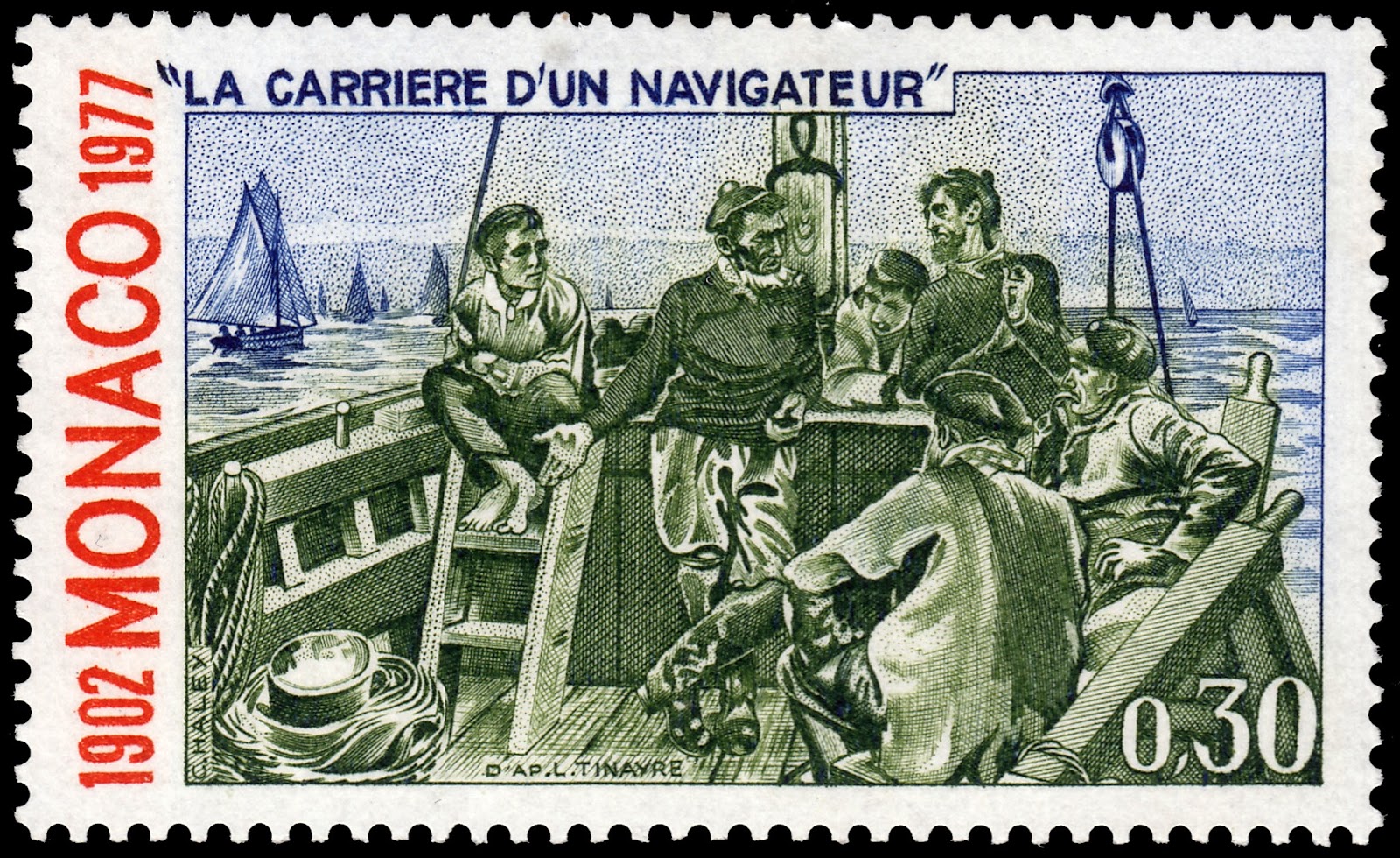
The 0,30f stamp was designed and engraved by Claude Haley. It features a lovely moment being shared by the crew members aboard one of Prince Albert I's research vessels.


***

The 0,80f stamp was designed and engraved by Michel Monvoisin. It features a splendid action shot of L'Hirondelle battling some rough weather. That wave in the background sure does look menacing!


Stay tuned for Part 2 of this gorgeous set next week!

Until then...

Saturday, 25 June 2016

Marie-Noelle Goffin

Marie-Noelle Goffin began her training at the age of 19 at the School of Fine Arts in Rouen. She spent four years there from 1954-1958. After this she continued her studies, deciding to specialise in engraving. In 1962 she received a National Engraving Diploma, which earned her a scholarship to study for a year at the School of Fine Arts in Amsterdam. Marie-Noelle then went on to teach at the school of Fine Arts in Lilie for 26 years as a Professor of drawing and engraving. She has also worked for the French Post since 1976. Marie-Noelle is also vice-president of the World Academy of Philately.

On 11 October 1976 the first Marie-Noelle Goffin stamp was issued in France. The subject of the stamp was Theirs, a commune in the Puy-de-Dôme department in Auvergne in central France. As mentioned above the stamp was designed by Goffin, and it was engraved by Eugène Lacaque.  The design is fantastic.


***

In 1977 Goffin designed and engraved her first stamp for France, showcasing the Collegiate Dorat. It was part of a set of six tourism stamps.


***

Over the years Goffin has engraved some 70 odd stamps for France and several for the French Colonies. Her engravings are bright, crisp, and full of life. It is really nice to see engravers such as Goffin prolonging the life of the declining art of stamp engraving. She is continuing to delight engraved stamp collectors in a style that well fits the modern era of philately.

Monday, 21 March 2016

Sweden 1977 - Owl

I just came across this beautiful stamp issued by Sweden on 8 September 1977. It was engraved by Martin Morck, who began his engraving career for Sweden. This was his first engraved stamp. And boy, what a ripper!!


Morck has engraved a lovely image of a Tawny Owl (my thanks to Adrian at Stamp Engravers for the owl info). Just look at the stunning artistry!!

Until next time...

Stay Engraver Crazy!