Showing posts with label Decaris (Albert). Show all posts

Monday, 2 October 2017

France 1957 - Europa

Way back in 1956 a decision was made to create a common design stamp issue for the European community. The idea was not only to promote the rewarding pursuit of philately, but also to educate people in the history of Europe and the common roots that Europeans share. Thus the EUROPA stamp issue was born. Initially, there were six participating countries: Belgium, France, Germany, Italy, Luxembourg, and Netherlands. All participating countries issued stamps of the same design to be produced in their own countries, using their own printing techniques and engravers when applicable. The common design chosen for the first EUROPA issue was a tower in the form of the 6 letters of the word EUROPA. The design was created by Frenchman Daniel Gonzagu. France's first EUROPA stamps were issued in two values, and the 'common' design was engraved by Jules Piel. 


In 1957 EUROPA allowed participating countries to issue stamps based on the common "theme" instead of a common design. The theme was Peace and Welfare through Agriculture and Industry. This idea of providing the participating countries with just a theme gave individual designers freedom to come up with their own artistic interpretation of the theme. Incidentally, the number of participating countries had now risen to eight to include Saarland and Switzerland.

***

On 16 September 1957, France issued its EUROPA design, printed in two values. The issue was designed and engraved by Albert Decaris. Decaris has brilliantly captured the essence of the theme in his design. It features two hands. One hand is holding an olive branch and wheat, symbolising peace and prosperity through agriculture. The other hand holds a large gear, through which another olive branch is entwined. Machinery and nature are here almost one with each other in a symbiotic relationship.


Until next time...


Wednesday, 27 September 2017

France 1956 - Benjamin Franklin

To say he was a man of many talents would be a massive understatement. He was the very definition of the title "polymath". Inventor, scientist, politician, printer, and diplomat to name but a few of his pastimes. The man, if you haven't already guessed, is Benjamin Franklin. 

To write an in-depth biography of Benjamin Franklin I'd need far more space than I usually allow for a blog - probably need a rather large book actually! So what I'll do here is try to concentrate on some of the more uncommon things about Benjamin Franklin. First off let's quickly get acquainted with Benjamin Franklin. He was born in Boston, Massachusetts on January 17 1706. His father, Josiah Franklin, was a soap and candle maker. Josiah had two wives, fathering seven children with the first, and a staggering ten with the second wife! Ben was the fifteenth child. Ben started out working in his father's shop, but melting wax all day wasn't for him. He then tried his hand at the printing business under the tyrannical rule of his brother. He hated working for his brother, so he struck out on his own by moving to Philadelphia. From here his career thrived.

Now to some things about this great man that I personally didn't know.  Ben Franklin is rather famous for his inventions such as bifocal glasses and the lightning rod. But I did not know that he also invented the flexible urinary catheter. I also didn't know that he never chose to patent any of his inventions, believing that they should be freely accessible to all.

Franklin also revitalized the idea of Paying it Forward. This is the concept of doing a good deed of some kind to a person and instead of the person paying you back they in turn do a good deed for someone else. An excellent practice in my opinion. This idea was first introduced as a key plot in Menander's play Dyskolos (The Grouch) which was performed in Athens in 317 BC. In a letter to Benjamin Webb dated 25 February 1874 Ben Franklin suggests the use of such a concept.

Another interesting tidbit I just read about. Ben was a very accomplished chess player, and his travels in Britain and France gave him the opportunity to duke it out with some of the greatest chess minds of the time.. When in Paris, both as a visitor and later as ambassador, he visited the famous Café de la Régence, which France's strongest players made their regular meeting place. Unfortunately, no records of his games have survived, so it is not possible to ascertain his playing strength in modern terms.

I also didn't realize Ben Franklin was the first Postmaster General of the United States. And interestingly, aside from George Washington,  Ben Franklin appears on US postage stamps more than any other famous person. He first appeared on a US postage stamp in 1847. 


Benjamin Franklin also appeared on the famous long-running Washington-Franklin series from 1908 to 1923. And many more issues, but amazingly on only a few commemorative issues. One commemorative issue he did appear on was engraved by perhaps the best stamp engraver in the world, Czeslaw Slania. This stamp issued in 1983 was a joint issue with Sweden.


He died on April 17 1790 in Philadelphia, Pennsylvania at the ripe old age of 84. 

***

On 12 November 1956 France issued a set of six stamps featuring famous foreigners who worked in France. One of the stamps features Benjamin Franklin, who, as mentioned above, worked as a ambassador in France. The stamp was designed and engraved by Albert Decaris. In this design, Decaris captures the witty and playful nature of Franklin not seen in a lot of his portraits. I like this stamp. It was fun and quirky.


Until next time...


Thursday, 21 September 2017

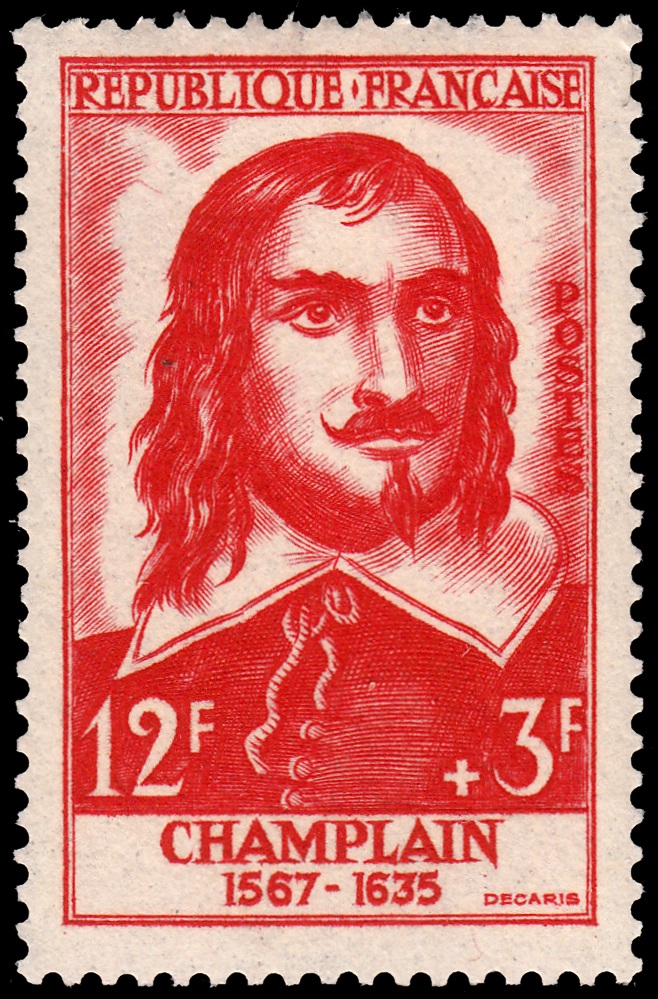
France 1956 - Samuel de Champlain

His skills and accomplishments were numerous. Among other things, he was a navigator, cartographer, draftsman, soldier, and explorer. He was instrumental in the founding of Quebec City. And he was later dubbed "The Father of New France". So who is this rather remarkable fellow? We are, of course, talking about none other than Samuel de Champlain.

Samuel de Champlain was born in Brouage, France. There is some contention as to the actual date of his birth. Some say as early as 1567. Other theories include dates up to and including 1575. Scholarship is now fairly certain he was born on or before 13 August 1574. Whatever the year of his birth was, we do know that he began his life as an explorer and seaman in 1598 when he travelled on the ship Saint-Julien with his uncle-in-law. The ship had been commissioned to carry Spanish troops to  Cádiz. During the journey, which was apparently long and hard (over two years) Champlain was given the opportunity to "watch after the ship". This was an excellent opportunity for him to learn the art of seamanship - to "learn the ropes" as it were. And Champlain also took the opportunity to hone his burgeoning writing and cartography skills. He wrote detailed notes of his journey, including illustrations. So good was the work that upon return to France, King Henry IV rewarded Champlain with an annual pension. Then when his uncle died in 1601, he left Champlain his considerable estate along with a merchant ship. His future as an explorer was set.

In 1603 he made his first voyage to North America as an observer on a fur trading expedition. Making the trek across the Atlantic and exploring parts of North America became second nature to Champlain. Indeed, in 1604 and again in 1605 he was back over there, exploring the eastern coastline as far south as Cape Cod.

But it was in 1608 that Champlain would forever cement himself in the annals of history. Sent back across the Atlantic at the command of a fleet of three ships to find a suitable spot for a colony on the St Lawrence River, he came across a nice spot which he would name "Quebec", which comes from the Algonquin word kébec meaning "where the river narrows". This was the origin of Quebec City. The first settlement consisted of three buildings, a stockade, and a moat, which Champlain called the "Habitation". The Habitation became Champlain's lifelong passion. He even built himself a large dwelling he called Fort Saint Louis.

Throughout his life, Champlain also settled the area that became the city of Montreal, and he made detailed maps of the Atlantic coast and the Great Lakes. By 1620 he had settled into an administrative role as the de facto governor of New France from a command post in Quebec. Samuel de Champlain died on December 25, 1635, in Quebec.

***

On 11 June 1956 France issued a set of six stamps honouring famous French people. One of the stamps features Samuel de Champlain. The stamp was designed and engraved by Albert Decaris. The stamp is a semi-postal with a face value of 12f with a 3f surcharge for the benefit of the Red Cross. When I first saw this stamp I wasn't really all that enamoured by it. But over time I have come to like it. The strong bold lines and the penetrating eyes of the explorer, the eyes of a visionary. And of course I love the beard!


I'd like to end this blog with a nice little quote by Champlain himself:
“The advice I give to all adventurers is to seek a place where they may sleep in safety.”
—Samuel de Champlain
Until next time...


Saturday, 16 September 2017

France 1956 - Marshal Franchet of Esperey

Considered by some as the personification of a howitzer shell with the steely disposition of a tyrant, Louis Félix Marie François Franchet d'Espèrey, was a French General during World War I. Yet outside his tough military demeanor, d'Espèrey was a kind man with, as we shall see, the heart of an adventurer.

D'Espèrey, born 25 May 1856 in Mostaganem in French Algeria, was the son of a cavalry officer in the Chasseurs d'Afrique. Following in his father's footsteps, d'Espèrey began his life-long military career in 1876 after being educated at Saint-Cyr. Before the outbreak of World War I, d'Espèrey had already forged a distinguished career. After serving in a regiment of Algerian Tirailleurs (native infantry), he served in French Indochina, and then in China during the Boxer Rebellion in 1900. He was then packed off to France where he was given command of various infantry regiments in France. He obviously did something right, as in 1913 - just a year before the war - he was given command of I Corps.

During WWI, d'Espèrey served on several fronts. Most notably, he was given command of the large Allied army based at Salonika. It was in this role that he led "the successful Macedonian campaign, which caused the collapse of the Southern Front and contributed to the armistice" (Wikipedia). After the war his military successes continued with the command of operations against the Hungarian Soviet Republic in 1919. Then on 19 February 1921 he was given the honour of the title of Marshal of France.

Skipping ahead to 1924, we find d'Espèrey now in the role of inspector-general of France's North African troops. It was in this capacity that he "became interested in the strategic potential of the "grand axis" north-south route across the Sahara" (Wikipedia). And it was later in this same year that the adventurous spirit within d'Espèrey was unleashed.

On 15 November 1924, d'Espèrey joined a trans-Saharan expedition led by Gaston Gradis in three six-wheel Renaults with double tyres (see image below). Interestingly, this was Gradis' second trans-Sahara expedition, the first being earlier in that same year. Other members of the expedition included the journalist Henri de Kérillis, commandant Ihler, the brothers Georges Estienne and René Estienne, three Renault mechanics and three legionnaires. Overall the expedition travelled 3,600 km of rugged terrain to reach Savé in Dahomey on 3 December 1924. One can only imagine the stories of the adventures these intrepid explorers had to tell. Any one of them would have certainly made an entertaining dinner guest!


***

On 28 May 1956 France issued a stamp commemorating the 100th anniversary of the birth of Marshal Franchet d'Espèrey. The stamp was designed and engraved by Albert Decaris. In this design Decaris manages to capture the fierce pride and determination of a great French leader with the heart of an adventurer. It is also worth noting that Decaris has discreetly incorporated one of France's defining landmarks, the Cathedral of Notre Dame. Can you find it?


Until next time...


Thursday, 14 September 2017

1937 International Exposition in Paris

Let the festivities commence! From motorboat races on the Seine to the Grape Harvest Festival, and from World Championship Boxing Matches to Shakespeare in the park. The 1937 Exposition Internationale des Arts et Techniques dans la Vie Moderne (International Exposition of Art and Technology in Modern Life) had it all. The Expo was held from 25 May to 25 November 1937 in Paris, France. Countries from around the globe converged on the "city of lights" to flex their muscles of national pride. Participating countries were invited to build their own pavilions. Some pavilions were rather modest. While others such as the Soviet and Nazi pavilions opted more for the ostentatious and colossal. And can I say, downright ugly? You be the judge...


Speaking of colossal, these pavilions were tiny compared to the dreams of designer Eugène Freyssinet. He envisioned a centerpiece for the fair that went beyond epic and launched itself more into the realms of the ludicrous. A building that would dwarf the Eiffel Tower, which was custom-built for the 1889 World Expo. He designed a tower 701 metres (2,300 feet) tall! He called this monstrosity Phare du Monde (Lighthouse of the World). A lighthouse! Just what Paris, some 160 odd km from the sea, desperately needs! But that's not all. At the very top of this monumental skyscraper would be found a hotel, a restaurant, a massive sunroom, and a giant multi-story garage for approximately 400 cars. By the way, that last bit isn't a typo! So how the heck does one get 400 cars up some 700 metres? Why on a road of course! A road that winds itself around the outside of the tower. Because driving up a narrow winding street into the clouds would never lead to disaster, right? Thankfully, sanity prevailed and this scheme was deemed far too expensive to even contemplate. Below is an image that illustrates the scale of the Phare du Monde.


***

This World Expo was also a big deal in the world of philately. A group of France's best artistic minds were assembled to create a six stamp set that would be issued in twenty-four French colonies. This was the second omnibus series printed in France, the first being in 1931 for the International Colonial Exposition. Engravers such as Rene Cottet, Emile Feltesse, Pierre Munier, Antonin Delzers, and of course Albert Decaris contributed to the set. In fact, Albert Decaris both designed and engraved two stamps in this set. Below is a list of all colonies in which this set was issued.
  • Cameroun
  • Dahomey
  • French Equatorial Africa
  • French Guiana
  • French Guinea
  • French India
  • French Polynesia
  • French Sudan
  • Guadeloupe
  • Indo-China
  • Inini
  • Ivory Coast
  • Kwangchowan
  • Madagascar
  • Martinque
  • Mauritania
  • New Caledonia
  • Niger
  • Reunion
  • St. Pierre & Miquelon
  • Senegal
  • Somali Coast
  • Togo
  • Wallis & Futuna Islands
***

To show examples of all stamps from all colonies would take up far too much room. Over time I will add images of the stamps from all the colonies, which will be found under the 'Omnibus Issues' tab found at the top of my blog page. For the purposes of this blog let's take a look the French Guiana issue. Enjoy!

The 20c stamp was engraved by Rene Cottet.


***

The 30c stamp was engraved by Emile Feltesse.


***

The 40c stamp was engraved by Pierre Munier.


***

The 50c stamp was designed and engraved by Albert Decaris (for more Albert Decaris work click HERE).


***

The 90c stamp was engraved by Antonin Delzers.


***

The 1f 50 stamp was designed and engraved by Albert Decaris.


Until next time...


Thursday, 24 August 2017

Mauritania 1938 - Camels

The Sahara Desert constitutes almost 90% of its landmass. Camels are a typical mode of transport. And camel milk is offered to household guests. So where does one go for a camel ride in the desert or partake of some tasty of camel milk? The answer is Mauritania, more formerly known as Islamic Republic of Mauritania. Mauritania is located in West Africa. It is bordered by five other African countries as well as the Atlantic Ocean.

As I mentioned above, camels play an important role in Mauritanian daily life. The species of camel found in Mauritania, and indeed other areas of Africa, is the one-humped dromedary (C. dromedarius). Of the three known species of camel in the world, the dromedary is the most common. In Mauritania, camels are used for transport and they provide all important calcium in the diets of the locals in the form of milk and cheese. And even camel milk chocolate is now being produced!

***

Between 1938-1940, the Institut de Gravure issued a set of 34 definitive stamps for use in Mauritania. The set consisted four design types, one of which was engraved by Albert Decaris. This particular design features Mauritanian locals and their camels, and it was issued in seven different values. If you're a regular to my blogs, you will know that I like to collect and feature all values issued. I very much enjoy studying the effects different colours have on a design. Anywho, enough talk! Let's get to the images of this great design.


***

It is worth noting that the 40c & 45c values were issued in 1940. Which value colour is your favourite? For me it is the 50c purple stamp.

Until next time...


Thursday, 10 August 2017

France 1956 - Battle of Verdun

Human history has been witness to some of the most brutal acts of violence. Violence on a scale incomprehensible to imagine. Perhaps one of the most blood-soaked periods of our history was World War I, a war that claimed over 41 million souls. Staggering! And the worst of the battles in this time of mass slaughter was the Battle of Verdun.

World War I was the embodiment of a new age of warfare. New weapons of war such as the howitzer, the mightiest of these being Big Bertha, which could reign destruction on a enemy target up to 9 km away. It was also the dawn of the flying aces of aerial warfare. Who hasn't heard of the legendary Red Baron? Destruction also now came from underwater in the form of submarines, such as the classic German U-boats. And although chemical warfare had been around for a very long time, World War I saw the first mass use of such diabolical weaponry. Chemical agents such as tear gas, and more lethal agents like phosgene, chlorine, and mustard gas were being employed in an attempt to smoke enemies from entrenched areas.

Which leads us to the birth of an horrendous age, the age of Trench Warfare. The most famous arena for Trench Warfare in World War I was the Western Front, a vast area of land riddled with complex networks of trenches, an area where millions of French and Germany soldiers died for little or no gain in territory. Soldiers lived in appalling conditions, before, like lambs to the slaughter, they went 'over the top' of the trench to be mowed down by enemy artillery. It was a ludicrous method of warfare where soldiers died seemingly at the whim of their commanding officers, who, for want of anything better to do, ordered charge after charge. The British public referred to their soldiers as "lions led by donkeys". Indeed, on the first day of the Battle of the Somme, the British lost 60,000 men - a death toll difficult to comprehend.

The longest battle in the trenches was the Battle of Verdun from 21 February to 18 December 1916. I shall not belittle the sheer horror and complexity of this battle by trying to summarise it here. Instead, I will throw a few statistics your way. The Battle of Verdun was fought between French and German soldiers. It raged for 303 brutal days, and is considered one of the most costly battles in human history. It is currently believed that the total number of casualties in the battle amounted to 714,231. 377,231 of these were French and 337,000 German. Averaging out these staggering numbers we get roughly 70,000 casualties a month or over 2,300 a day! I can't even begin to imagine! For an in-depth analysis of the battle click HERE

***

On 5 March 1956 France issued a stamp commemorating the 40th Anniversary of the Battle of Verdun. Albert Decaris was given the honour of designing and engraving this important stamp. I think he did a beautiful job with this difficult task.


***

Over time, quite naturally, French Post have issued stamps commemorating this battle, all of which have been beautifully rendered. In fact, I believe there to be an interesting blog on that subject on the horizon. But for now, take a look at this page to peruse more Battle of Verdun stamps, click HERE

Until next time...


Friday, 4 August 2017

France 1961 - Aristide Maillol

A master tapestry designer, painter, and sculptor, Aristide Maillol was a man of many talents. Born 8 December 1861 in Banyuls-sur-Mer, Roussillon, France, Malliol apparently aspired from a young age to be a painter. In 1881 at the age of 20 he moved to Paris to study at the École des Beaux-Arts. Unfortunately things didn't work out as well as he had hoped. He applied to the art school several times and received rejection after rejection. By the time the school finally did accept his application in 1885, Malliol had been living for some time in poverty. I've been unable to find anything about he his studies went, but it would probably not be a stretch to say he did very well.

Mallol's early paintings were heavily influenced by contemporary greats Pierre Puvis de Chavannes and Paul Gauguin. In fact, Gauguin took an interest in Malliol's work, particularly his decorative art. Gauguin was so impressed that he encouraged Malliol in this direction, which led him to try his hand at tapestry design. Malliol excelled in this art form, and even opened his own tapestry workshop. Malliol gained critical acclaim for the work produced in his workshop. His work sparked a new wave of interest for tapestry design in France. 

But Malliol was keen to broaden his artistic horizons by experimenting in other mediums. In 1895 he began making sculptures in terracotta. Within a few short years Malliol was totally hooked on the art of sculpture. So much so that he completely abandoned his work with tapestry art. Indeed, Malliol is now probably most remembered by his beautiful sculptures celebrating the nude female form. One such sculpture was titled Woman aka The Mediterranean circa 1905. 


***

On 20 February 1961 France issued a stamp celebrating the work of Aristide Malliol. The stamp was issued just under one hundred years after his birth. It was designed and engraved by Albert Decaris. The subject of the stamp was the statue The Mediterranean as mentioned above.


I find this piece of work fascinating. It is the work of one artist, Albert Decaris, utilising his own artistic style to replicate a famous sculpture. I know what your probably saying: stamp engravers have reproduced thousands of pieces of art! That is very true. But within this stamp in particular I can discern the caricature-like style of Decaris blended with the unique talents of Malliol. An impressive piece of stamp art indeed!

Until next time... 


Tuesday, 25 July 2017

I Study... Aspects of an Airmail Design

Sometimes it is difficult admire the beauty of a lone tree amid a vast forest. This can also be the case when viewing a beautifully engraved stamp vignette with an elaborate border. It is true, of course, that the border should compliment the vignette, but I find it a bit of fun and quite interesting to separate the relative parts. I do this with the use of basic editing software. There are loads of editing software packages out there, and different people have their own preferences. I personally use Paint.net.  But enough of that. On with the show, as it were!

A great specimen to use for an exercise such as this is the France 1950 1,000f airmail stamp. Not only does it have a stunning vignette and lovely decorative border, each aspect of the design had a different engraver. This enables us to single out the vision of each engraver. It is true that I have already written a blog studying this stamp and the other stamps in this series - click HERE. But by employing the method mentioned above, hopefully we will see this stamp in a whole different light. And if not, it was a bit of fun.

***

First, let's take a look at the entire stamp.


***

Now let's manipulate the image a bit so we can focus solely on the vignette (central grey portion). This part of the stamp was designed and engraved by Albert Decaris.


There is instantly a different feel to the image. A smoky, dark presence yet an alluring quality that beckons us down into the design. To roam the narrow streets of Île de la Cité. To traverse the gorgeous, uniquely-styled bridges. To explore the stunning Cathedral of Notre Dame. Vraiment superbe!

***

It was actually only recently that I realised that the border of this stamp was not designed and engraved by Decaris. This magnificent border was entrusted to Jacques Combet. Let's take a look at it with the vignette removed.


The fine details sculpted into this border are quite amazing!  The feathered wings down each side of the border. The intricate scrollwork. I particularly like the sailing vessels to be found at each corner! This border is a stunning piece of art in and of itself.

***

Incidentally, this was not the only time these two engravers collaborated. In 1956 their talents were again combined to produce the 500f airmail stamp for St. Pierre et Miquelon, depicting a Douglas DC-3 over St Pierre Port. 


I believe Decaris was responsible for most of the work in this stamp and Combet engraved the lettering. Many thanks to Adrian at Stamp Engravers for his blog on this issue. To take a look at his blog post click HERE. It's well worth the read.

Anywho, enough from me for now. I hope you enjoyed this little exercise! What's the point of computers and all this fangled software if we can't play around with it from time to time?

Until next time...


Tuesday, 4 July 2017

France 1957 - Heroes of the Resistance

Resistance is 'the act of fighting against something that is attacking you, or refusing to accept something (Cambridge Dictionary, 2017)."

Our history books are riddled with heroic tales of resistance to foreign invaders. From the Greek resistance to the Persian invasion in the 5th century BC to the more recent Aboriginal resistance, led by Pemulwuy, to British occupation of their territory around Sydney, NSW, in 1797; and from the American resistance to the British Empire in the Revolutionary War to the French Resistance against German occupation during WWII. These brave acts of defiance bring with them stories of individual gallantry and heroism against overwhelming odds. 

One such hero was French Resistance fighter, Henri Honoré d'Estienne d'Orves. D'Estienne d'Orves, born 3 June 1901, was educated in some of the finest schools in Paris before joining the École Navale, (French Naval Academy) in 1923, where he was stationed on the training ship Jeanne d'Arc. Life in the Navy seemed to have agreed with d'Estienne d'Orves, and he quickly rose through the ranks. By the time World War II erupted in 1939 he was the under-chief of the headquarters of the 2nd flotilla of torpedo boats in Mediterranean Sea, and by December of that year he became an aide to Admiral Godfroy in the Headquarters of "Force X".

On 25 June 1940, an armistice was signed between France, led by Marshal Philippe Petain, and Germany, allowing German forces to occupy France. Unsurprisingly, not all of France was happy with this scenario. Many, such as General Charles de Gaulle, considered this tantamount to surrendering in defeat. Having fled into exile to London, de Gaulle spearheaded the "Free France" movement.

Unwilling to accept the armistice like so many others (including de Gaulle), D'Estienne d'Orves sailed from Africa to London aboard a cargo ship. On 27 September 1940 he met with Charles de Gaulle. Unable to obtain a sea command at this time, d'Estienne d'Orves was given a different mission by de Gaulle. On 15 December 1940, he was tasked with organising an intelligence network in western France, code-named "Nemrod".

Code-named "Jean-Pierre Girard", d'Estienne d'Orves set up his intelligence network headquarters in Chantenay-sur-Loire, near Nantes along with his radio operator, Alfred Gaessler, a 20 year old German-speaking Alsatian, with the code-name, "Georges Marty". Over the next several months, d'Estienne d'Orves created an efficient spying web, allowing him to gather intelligence pertaining to German military movements. Unfortunately, it turns out that d'Estienne d'Orves' radio officer, Gaessler, happened to be a double agent, informing the Nazis of the movements of d'Estienne d'Orves. On a trip to London, d'Estienne d'Orves was cornered by the Gestapo. But d'Estienne d'Orves didn't go easily. He and his companions put up a strong fight. Eventually, however, the Gestapo captured and arrested him. D'Estienne d'Orves was wounded in the fight. Thankfully, the spy web he had created remained undiscovered and continued to operate right up to the Liberation of Paris in August 1944.

D'Estienne d'Orves was held in prison by the Nazis to await trail, which began on 13 May 1941. At the trail d'Estienne d'Orves claimed full responsibility for the spy network. On 28 August he was found guilty of treason and sentenced to be executed. An anecdote that speaks to the character of d'Estienne d'Orves occurred shortly after the conclusion of the trail. When being interviewed by the German military judge who had sentenced him, d'Estienne d'Orves is reported to have said:
"Sir, you are a German officer. I am a French officer. We both served our duty. Please allow me to hug you (Wikipedia)."
At dawn on 29 August 1941, Henri Honoré d'Estienne d'Orves was executed by firing squad at Fort du Mont Valérien, France. But this man's heroism was most assuredly not forgotten. He was posthumously promoted to Capitaine de frégate (Commander) and made a Compagnon de la Libération (Fellow of the Liberation). And inspired by his martyrdom, many people joined the ranks of the French Resistance.

***

On 20 May 1957, France issued a set of five stamps honouring the Heroes of the Resistance. The 10f value depicting Henri Honoré d'Estienne d'Orves was designed and engraved by Albert Decaris. The portrait is a fitting testimonial to the courage, loyalty, and honour of Henri Honoré d'Estienne d'Orves. A true hero!


Until next time...


Sunday, 25 June 2017

France 1957 - Stamp Day

A felucca is a wooden sailing boat that is not only small and lightweight, but also extremely maneuverable. These characteristics make this style of boat perfect for rivers and protected waters. They are commonly found plying the waters of the Mediterranean and the Nile in Egypt. A felucca can be easily identified by its large triangular sails, which are called lateen sails. A felucca can be rigged with two or three lateen sails.

By the 18th century the popularity of this versatile craft spread to Italy and along the French Riviera. Here they were often used as passenger craft and for transporting items such as mail. By this point it was not uncommon to see feluccas fitted with up to twelve oars and a canopy at the stern to protect its passengers from the weather. There is a rather quaint mention of the use of a felucca in a mid 18th century travel book.
The most agreeable carriage from hence (Nice) to Genoa, is a felucca, or open boat, rowed by ten or twelve stout mariners. Though none of these boats belng to Nice, they are to be found every day in our harbour waiting for a fair to Genoa... A felucca is large enough to take in a post-chaise; and there is a tilt over the stern sheets where the passengers sit to protect them from the rain. Between the seats one person may lie commodiously upon a mattress, which is commonly supplied by the patron. ... I would advise every valetudinarian who travels this way, to provide his own chaise, mattress, and bed-linen, otherwise he will pass his time very uncomfortably. (Smollet, London, 1884, p 746)
Towards the end of the 18th century the popularity of feluccas had travelled even farther afield, all the way to the west coast of USA. To San Francisco to be exact. In 1884 a whole fleet of feluccas was put to work in the bay as fishing trawlers.

***

Over the years France has issued some stunning stamps to celebrate Stamp Day. The stamp chosen for Stamp Day 1957 was no exception. In fact, it is one of my personal Stamp Day favourites. The stamp in question was designed and engraved by Albert Decaris, and it was issued on 18 March 1957. Like other Stamp Day issues it was a semi-postal with a value of 12f + 3f. The 3f surcharge went to the French Red Cross.


The subject of the design was an 18th century feluccia, which, as mentioned above, often carried mail. Decaris had a tremendous liking for maritime engravings, a passion which is clearly evident in this design. I think it is superb. The sleek lines of the hull slciing through the water. The sails billowing as they snatch the cool breeze. And the oars, poised for another stroke...

***

I also have a copy of this lovely stamp in a border pair, which is sublime.


Until next time...


Tuesday, 13 June 2017

France 1949 - United Nations in Paris

The atrocities of World War II must never again be allowed to occur! This was the basic premise to the formation of the United Nations. Without going into lots of details, the United Nations was established on 24 October 1945, a replacement to the League of Nations, which did not work as well as intended. Initially 51 member states signed up to join the UN. These days that number has risen to 193. 

The official headquarters of the UN is located in Manhattan, New York City with three further offices in Geneva, Nairobi, and Vienna. Its objectives have outgrown its initial premise somewhat. It strives to maintain international peace and security, and it seeks to promote human rights through things like humanitarian aid during times of crisis such as famine, natural disaster, and war. The UN also works to protect our natural environment.

In order to run effectively, the UN mechanism has six main components (from Wikipedia):
  1.  General Assembly (the main deliberative assembly)
  2. Security Council (for deciding certain resolutions for peace and security)
  3. Economic and Social Council (ECOSOC; for promoting international economic and social co-operation and development)
  4. Secretariat (for providing studies, information, and facilities needed by the UN)
  5. International Court of Justice (the primary judicial organ)
  6. UN Trusteeship Council (inactive since 1994)
For this blog post our main focus is the General Assembly. The first session of the UN General Assembly was convened on 10 January 1946 in the Methodist Central Hall in London and included representatives of 51 nations. But since an official headquarters had as yet been created, the next five sessions of the Assembly were held in different locations. Two such sessions were held in Paris. The first Paris session was in 1948. The second Paris session began on 6 November 1951. This session was held at the Palais de Challiot
\
The Palais de Challiot was built for the Exposition Internationale of 1937, on the site where the old Palais du Trocadéro had stood before being demolished. It is perhaps worth noting that Adolf Hitler was pictured on the front terrace of the palace with the Eiffel Tower in the background during his tour of Paris in 1940. This photo became an iconic image of World War II.

***

On 6 November 1951 France issued a set of two stamps bearing the same design for the opening of the UN General Assembly in Paris. This issue was designed and engraved by Albert Decaris. The design features the Palais de Challiot in the foreground with the Eiffel Tower standing proudly in the centre background. This design was issued in two values, each with its own colour.


***

One thing I find interesting about this issue is the 18f red. The ink seems to be quite thick, which blurs much of the fine detail. This is reminiscent of the 1948 Luxembourg Palace 12f issue printed in carmine. In the Luxembourg Issue a lot of details are blotted out. This is perhaps a reflection of the consistency of the red pigmented ink of this vintage.  


Until next time...


Monday, 22 May 2017

Monaco 1975 - Carmen: Act IV

They say variety is the spice of life! So to make the month of May nice and spicy I have dedicated the entire month to the four stamp 1975 Monaco series celebrating the 100th anniversary of the opera Carmen. The set was issued on 13 May and it was designed and engraved by Albert Decaris. Since Carmen is in four acts and each of these acts has been illustrated with its own stamp, each week's blog has been a "one act wonder" so to speak. This week it is time for Act IV. The finale! If you wish to review any or all of the story so far, here are the links to each Act of the opera. Act I. Act II. Act III.

As I have mentioned in the previous three blogs dedicated to this opera, Carmen is a tale of seduction, passion, infidelity, jealousy and murder. It was first performed at the Opéra-Comique in Paris on 3 March 1875. It was considered quite scandalous for its time! 

***

Act III ended with José heading back down to the town after having been convinced that his mother is ill and needs him. But before he leaves he tries to prevent Carmen from rushing off into the arms of Escamillo. Let's see how that panned out!


ACT IV

The lights come on. We are in the square in front of the bull-fighting arena at Seville, Spain c. 1920. It is the day of the bull-fighting contest.

The square is jam-packed with people. Merchants are crying their wares. Gypsies are performing for the crowds. It's party-time! The attention soon focuses on the two friends of Carmen, Frasquia and Mercédès. They are talking to the soldier, Zuniga (he is the guy José has had a couple of entanglements with). They tell him that Carmen is now with Escamillo.

Then the bull-fighters arrive and the crowd goes wild. Carmen is indeed with Escamillo. They openly express their love in front of the crowd. Carmen cries out that she has never loved anyone as much as Escamillo.

As Escamillo goes into the arena surrounded by screaming fans, Frasquita pulls Carmen aside and warns her that José is somewhere in the crowd. Carmen looks at her and blows her off. She turns, about to enter the arena, when José appears and grabs her. He is desperate. She tries to pull away but he begs her to stay with him. He says that they can move away and have a new life together. If only she will love him back. She pauses, perhaps considering the request. But then she tells him quite bluntly that she does not love him at all. 

Suddenly cheers erupt from the arena in the background. Carmen desperately wants to go in, but José, relentless, won't let her. He begs her yet one more time. This time Carmen replies with a scornful rebuke. José becomes incensed. Then, as the crowds in the arena are chanting the name "Escamillo" José pulls out a knife and plunges it into Carmen's heart (I am assuming heart!). As Carmen drops to the ground dead, a chorus of the "Toreador Song" can be heard in the background.

José kneels over the body of Carmen, declaring his guilt over her murder, as the crowds pour out of the arena. We are then left to ponder the fate of José. Is he punished by the law for his deed? Does Escamillo take revenge on the killer of his lover? Or does José flee to live out the rest of his life in guilt-ridden torment? 

***

Time to reveal the Act IV - and final - stamp!


What a beautiful stamp! In he foreground we see Carmen and Escamillo in a lovers' embrace. While off to the right, we see José staring them down, perhaps plotting some way of winning back the love of Carmen? Just check out the engraved detail of Carmen's dress. Not to mention the gorgeously-rendered bull-fighting arena in the background. Just...Wow!

So, there you have it. The four Acts of Carmen and the corresponding stamps. What an amazing set! Bravo, Albert Decaris! A superlative polyptych piece of art. Which stamp was your favourite? I really can't decide...

Until next time...


Monday, 15 May 2017

Monaco 1975 - Carmen: Act III

Carmen is an opera that involves seduction, passion, infidelity, jealousy and murder. It was first performed at the Opéra-Comique in Paris on 3 March 1875. It was considered quite scandalous for its time, and the reviews and audience reactions were far from positive. In fact, the opera was more popular overseas. and it wasn't revived in Paris until 1883, eight years after its initial release.

***

On 13 May 1975 Monaco issued a set of four stamps to celebrate the 100th anniversary of the premiere of the opera, Carmen. This beautiful set of stamps was designed and engraved by Albert Decaris. Each stamp represents one of the four Acts of the opera. In the last couple of blogs we were introduced to Carmen with an in-depth look at Act I and Act II of the opera and their related stamps. Click HERE to read about Act I. And HERE for Act II.

***

Act II ended with Carmen, José, and a couple of smugglers fleeing the Inn together to get away from the senior officer with whom José had just fought. So what will happen to the runaways...?

ACT III

The lights come on. We are deep in the wilds of the mountains near Seville, Spain c. 1920. It is night time.

Carmen, a couple of her friends, José, and the smugglers are travelling further into the mountains. At some point during the journey, Carmen has become bored with the company of José. Hoping to be rid of him she starts taunting him and telling him to go back to the village. But he knows he can't. After fighting a superior officer, he would be charged immediately.

They find a spot to hide. Carmen's friends, Frasquita and Mercédès, pull out a set of fortune-telling cards to kill some time. Carmen joins them, they read her fortune. Carmen is stunned when they tell her that the cards foresee hers and José's deaths. Watching the women, the smugglers get an idea. They decide to take the women down into the town to the customs officials and have them use their feminine charms on them in order to move their contraband. They leave José there alone with the stash.

Not long after, José's sweetheart, Micaela (who we met in Act I), comes into the mountains. She spots José before he sees her. She is about to approach him when she hears him fire his gun. She hides behind some rocks, thinking he might be shooting at her. But she soon finds out that he actually is shooting at a man approaching. The man resolves from the shadows. It is Escamillo, the toreador. José, recognising the toreador, relaxes his guard and the two start chatting. 

However, the atmosphere soon becomes tense when Escamillo starts talking about a woman he has fallen for, a woman named, Carmen. And worse still Escamillo says that she seems infatuated with some common soldier. He has no idea the soldier is José! Enraged, José challenges him to a knife fight. But Escamillo merely defends himself and doesn't fight back. Now José is really annoyed! He comes at the bullfighter again. Escamillo manages to get the better of him, but lets him go. He says he fights bulls not men! José attacks him for a third time. This time Escamillo's knife breaks. José has a chance...

...but then Carmen reappears with the smugglers. Escamillo takes the opportunity to leave. But before he does, he invites Carmen and the smugglers to his next bullfight in Seville. As Escamillo departs, Micaela is spotted hiding in the rocks. She comes out and begs José to return home with her as his mother is very sick. Carmen mocks him, telling him to run along home. After some more begging by Micaela, José agrees to go, but he promises Carmen he will return to her.

As José starts to walk off, the voice of Escamillo singing the toreador song can be heard. Carmen's eyes light up and she makes to dash off to find him. But José turns around and stops her from leaving...

***

Time for the Act III stamp.


In this lovely engraving Decaris has decided to capture the moment when Micaela starts begging José to return home with her. Micaela's dress has been picked out n stunning green. And the sash around José's waist is also green, illustrating their connection. 

In this image we can clearly see José's reluctance to leave with Micaela by his posture. And to the left we see Carmen, standing there, mocking him. If you look closely you see the rose José gave her between her breasts. Perhaps taunting José. Again, a splendid composition!

Until next time... 

Sunday, 7 May 2017

Monaco 1975 - Carmen: Act II

Carmen is an opera that involves seduction, passion, infidelity, jealousy and murder. It was first performed at the Opéra-Comique in Paris on 3 March 1875. It was considered quite scandalous for its time, and the reviews and audience reactions were far from positive. In fact, the opera was more popular overseas. and it wasn't revived in Paris until 1883, eight years after its initial release.

An Early Carmen Poster

On 13 May 1975 Monaco issued a set of four stamps to celebrate the 100th anniversary of the premiere of the opera, Carmen. This beautiful set of stamps was designed and engraved by Albert Decaris. Each stamp represents one of the four Acts of the opera. In last week's blog we were introduced to Carmen with an in-depth look at Act I and the first stamp in the set. Click HERE to read about Act I.

***

Act I ended with Carmen tricking a soldier named, José Morales, to let her go after she had attacked a workmate with a knife. So what next? Let the curtain rise for...

ACT II

The lights come on. We are in an Inn owned by Lillas Pastia, in Seville, Spain c.1820. Two months have elapsed since the events of Act I.

Carmen is partying at the Inn with some friends and entertaining the soldiers present. One of the soldiers is Zuniga, the officer who arrested Carmen in Act I for wielding the knife. He approaches Carmen and tells her that José has just been released from his two month imprisonment for letting her go. She is delighted at this news! Probably because she starts thinking how she can further manipulate the poor guy.

Suddenly there is noise outside as a procession approaches, announcing the arrival of the toreador, Escamillo. Toreador's were like rock-stars back then. Escamillo enters and announces himself with the "Toreador Song". He grabs a drink and makes a toast: Votre toast, je peux vous le rendre! Then he sees Carmen and makes a beeline for her. But Carmen ignores him.

Then the owner of the Inn, Lillas Pastia, gets rid of the crowds and the soldiers. Only Carmen and her two friends remain. They are chatting, when two shady-looking characters enter. These guys are smugglers. They tell Carmen and her friends that they want to get rid of some contraband they just got their hands on. Carmen isn't interested, but her two friends are. Carmen is only interested in seeing José again. The smugglers give up and leave.

A short time later, José turns up. Carmen immediately launches into a private exotic dance just for him. Je vais danser en votre honneur (I will dance in your honour). But Carmen's intimate dance is rudely interrupted by the bugle call from the soldier barracks. José turns to leave, which angers Carmen. She obviously thinks he doesn't really like her after all. But José produces the rose that Carmen had thrown at his feet in Act I. This romantic act is seemingly not enough to impress Carmen. She mocks him, and tells him that the only way she will possibly believe him is if he runs away with her, abandoning his military post. José flatly refuses. He doesn't want to desert.

He is about to leave and return to the barracks when his officer, Zuniga, returns. Zuniga obviously has the wrong idea, thinking that José is planning to run away with Carmen. The two men fight. During the fight, the smugglers return and separate the pair. Unfortunately, José has now dug himself a grave by assaulting a superior officer. He now has no choice but to flee the scene with Carmen and go into hiding. They quickly leave the Inn with the two smugglers...

***

Now it is time to reveal the stamp for Act II.


This lovely stamp, with its sumptuous use of deep red, draws us into the Inn of Lillas Pastia. The main focus of the design is Escamillo, the toreador, singing to Carmen and her friends. He is in red. Decaris has placed bull heads in the top corners of the design to remind us of Escamillo's bull-fighting prowess. These are also in red. In the background to the left we see another figure in red. This is José. Lurking, waiting to enter the scene. Much like the toreador was lurking off to the side in the first stamp. Decaris' use of red to highlight the central themes of the Act is a stroke of genius.

***

The attention to detail in this stamp is incredible. Especially striking are the women's costumes.


Until next time...


Tuesday, 2 May 2017

Monaco 1975 - Carmen: Act I

A story of seduction, passion, infidelity, jealousy and murder. The essential ingredients of a good crime thriller. But what about an opera? Surely an opera with such themes would be scandalous! Well, such an opera does exist, and, yes. when first performed it was quite the scandal. This opera was Carmen.

***

Carmen is an opera presented in four acts. (I intend to replicate this four act structure for my Carmen blog series, but more on that later). The opera was composed by Georges Bizet, a French composer. The libretto of Carmen was written by Henri Meilhac and Ludovic Halévy, The libretto is basically the text portion of an opera. The libretto for Carmen was based on a novella of the same title by Prosper Mérimée. 

Carmen was first performed at the Opéra-Comique in Paris on 3 March 1875. The reviews and audience reactions were far from positive. In fact, the opera was more popular overseas. and it wasn't revived in Paris until 1883, eight years after its initial release. 

Opening Night Poster

So what was this seemingly controversial opera about? The story is set in southern Spain, and it focuses on a young soldier by the name of José Moralès. At the beginning of the story José seems happy; he has a steady job, and he is sharing his life with his childhood sweetheart. That is until Carmen enters the picture. Carmen is a gypsy with fiery passions. She seduces José, who falls for her charms. Unfortunately like many love-struck young men in stories, he abandons his life to be with Carmen. But Carmen is just using him. She in turn abandons José and turns her attention to an attractive toreador, Escamillio. In a fit of jealous rage, José kills Carmen. If he can't have her love, no one can! Carmen's tragic death actually takes place on-stage. Slaying your main character is a risky strategy. Probably one of the main reasons for the lack-lustre reviews upon its premiere in 1875.  

***

On 13 May 1975 Monaco issued a set of four stamps to celebrate the 100th anniversary of the premiere of the opera, Carmen. This beautiful set of stamps was designed and engraved by Albert Decaris. Each stamp represents one of the four Acts of the opera. Since this set was issued in May and it now is May, I have decided to do something a little different this time around. Instead of showing all four gorgeous stamps at once, I am going to do them one Act at a time. That will amount to one Act each week for the month. So without further ado, let the curtain rise for...

ACT I

The lights come on. We are in a square, in Seville, Spain c.1820. To the right, we can see a door to the tobacco factory.  To  the left, we see a guardhouse. And at the rear of the stage there is a bridge.


There is a small group of soldiers standing about, chatting with each other in the square, while waiting for the changing of the guard. A woman approaches, named Micaëla. She asks after José Moralès. They tell her he will arrive with the change of guard. She leaves, promising to return later. Then the new guard arrives, and with them José Moralès.

Shortly after this the cigarette factory bell rings, and a large group of young women emerge. One of the women is Carmen. She approaches the soldiers and starts singing L'amour est un oiseau rebelle (Love is a rebellious bird). A song designed to inflame their passions. Many of the men start begging to be her lover. José Moralès is not one of the men. But she chooses José Moralès by throwing a rose at his feet. He is annoyed with her and doesn't respond. If only he had stuck to his guns!

Then things start to heat up a bit. The women go back to the cigarette factory. Micaëla returns to find José. She gives him a letter and a kiss from his mother. He says, "Parle-moi de ma mère!" (Tell me about my mother). In the letter, his mother tells him to return home and marry Micaëla so they can live happily ever after. He is about to say yes...

When there is a sudden commotion at the cigarette factory. An officer emerges with a very angry Carmen. He tells José that she attacked another woman with a knife. Carmen cries out, "Coupe moi. Brûle-moi!" (Cut me. Burn me). José is ordered to bind her hands and take her to the prison. 

After everyone leaves, Carmen seizes the opportunity to sing to José about what it would be like to spend a passion-filled night with her, He is bewitched by her. Spellbound, he unties her bonds. Then she pushes him to the ground, throws her head back in laughter, and runs away. Poor José is then arrested for dereliction of duty.

***

Now we come to the stamp. Decaris has captured the theme of Act I beautifully. 


In the background we can make out the sets. The factory. The guardhouse. And the bridge. 


In the foreground we see Carmen flirting with José Moralès. She is smoking a cigarette to suggest of being a worker in the cigarette factory. And if we look closely we can see the rose in Carmen's mouth, ready to be thrown at José's feet. 


And despite the fact that the toreador has yet to enter the story, Decaris has decided to depict him off to the right, looming, yet to be engaged. But he is there. A reminder of the love triangle to come. 


Stay tuned for Act II next week!

Until then....