Showing posts with label *Monaco. Show all posts

Monday, 20 November 2017

Monaco 1977 - The Career of a Navigator 1st Issue (Part 2)

Oceanography is: "a science that deals with the oceans and includes the delimitation of their extent and depth, the physics and chemistry of their waters, marine biology, and the exploitation of their resource" (Meriam-Webster.com).

***

In last week's blog we were introduced to Prince Albert I of Monaco, a trail-blazer in the field of oceanography. His contributions to this discipline and his career as a navigator were celebrated in a sumptuous series of 18 stamps, issued in two sets of nine in 1977.

One of Prince Albert's crowning achievements was the founding of the Oceanographic Institute in 1906. One part of the institute is the Monaco Oceanographic Museum, located in Monaco-ville. The museum is a  stunning piece of architecture in the baroque revival style. It was built into the side of a cliff face overlooking the ocean, and it took workers some eleven years to complete.


***

The museum was inaugurated in 1910 by Prince Albert I. In looking up the history of the museum, I was surprised to discover that the great Jacques Cousteau was the director of the museum from 1957 to 1988. I recall watching Mr Cousteau on TV as a kid. The singer/songwriter John Denver wrote a song dedicated to him, called Calypso, which was the name of Cousteau's boat. The museum is also known as the Jacques Cousteau Museum.

The museum is home to a large variety of sea fauna such as starfish, turtles, sea urchins ,jellyfish, crabs, sharks, lobsters and many more sea critters. There are even some skeletons!


It is also home to an amazing octopus sculpture.


***

In 1902 Albert I published a book La Carriere d'un Navigateur (The Career of a Navigator), which documents his adventurous life at sea. On 3 May 1977, the 75th anniversary of the publication of his magnum opus, Monaco issued a glorious set of 18 stamps, issued in two sets of nine, honouring the Prince's achievements. To engrave this mammoth issue, a stellar cast of French engravers was enlisted: Pierre Gandon, Claude Haley, Michel Monvoisin, George Betemps, and Pierre Forget. This set was created based on illustrations by the French illustrator Louis Tinayre (14 March 1861-26 September 1942).

Last week we kicked off by studying the first four stamps in this first series. This week we will study the last five stamps in this series. And they are truly gorgeous. Maintenant examinons les timbres!

***

The 1f stamp was designed and engraved by Georges Betemps. It features a night-watch helmsman at the wheel of one of Prince Albert's yachts, perhaps l'hirondelle. I love this stamp. The depths of the darkness give it a sense of brooding mystery. And the illumination from the binnacle lamps splashing over the sailor is fabulous.


***

The 1f 25 stamp was designed and engraved by Pierre Forget. It features a dynamic scene in which L'hirondelle battles a raging storm. The artist has managed to create a very real sense of fear and impending danger in this stamp.


***

The 1f 40 stamp was designed and engraved by Claude Haley. It features a group of researchers, perhaps including Prince Albert himself, out in a longboat, fishing for shrimp.


***

The 1f 90 stamp was designed and engraved by Pierre Forget. It features a scene in which the trawl is being hauled aboard for further investigation. 


***

The 2f 50 stamp was designed and engraved by Georges Betemps. It features the capture of an oceanic sunfish for analysis.


Stay tuned for the second series of this wonderful set.

Until next time...


Tuesday, 14 November 2017

Monaco 1977 - The Career of a Navigator 1st Issue (Part 1)

He was born into royalty, but he possessed the heart of a scientific explorer with a passion for the relatively new field of oceanography. Honoré Charles Grimaldi, later Prince Albert I of Monaco, was born 13 November 1848. His love for the ocean was perhaps cultivated while he was still a young man serving in the Spanish Navy. Then during the Franco-Prussian War (19 July 1870 – 10 May 1871) he joined the French Navy. In this capacity he excelled, earning himself the Legion of Honour. 

Throughout his life, Prince Albert's love for oceanography was evident in nearly every aspect of his life, but he also had a keen interest in unravelling the mysteries of the origins of man. In fact, he founded the Institute for Human Paleontology. The institute went on host a number of archaeological digs. During one such dig "Grimaldi Man" was found in the Baousse-Rousse cave, and it was named in his honour. 

As a skilled navigator and a trail-blazer in the burgeoning field of oceanography, Prince Albert devoted his life to the study of oceans and aquatic life. In all, he led 28 scientific expeditions around the Mediterranean, to the Azores, and even an adventure to the Arctic. In order to make the most of these research expeditions, he had several ships retro-fitted with high-tech (for the time) scientific equipment. He had four ships in total: Hirondelle, Princess Alice, Princesse Alice II and Hirondelle II. But what is field research without a home base? To this end, he founded the Oceanographic Institute in 1906, which is comprised of two establishments: the Oceanographic Museum in Monaco (for which there was a lovely stamp series issued) and the Home of the Oceans in Paris.

Housed within the Oceanographic Museum is the Salle Albert I, an exhibit dedicated to his exceptional career as a navigator and oceanographer. It houses numerous marine specimens, photos, and a library of scientific analysis. It also includes several display models, including miniatures of his research ships and even a full size sperm whale!  

***

In 1902 Albert I published a book La Carriere d'un Navigateur (The Career of a Navigator), which documents his adventurous life at sea. In 1977, the 75th anniversary of the publication of his magnum opus, Monaco issued a glorious set of 18 stamps, issued in two sets of nine, honouring the Prince's achievements.. The first set, which I will focus on in this blog, was issued 3 May 1977.  To engrave this mammoth issue, a stellar cast of French engravers was enlisted: Pierre Gandon, Claude Haley, Michel Monvoisin, George Betemps, and Pierre Forget. They even brought in a top gun outsider a fellow whose name you may have heard of one or twice - Czeslaw Slania! This set was created based on illustrations by the French illustrator Louis Tinayre (14 March 1861-26 September 1942).

***

Considering this set is so big, I have broken it into two separate blog posts. This week we will study the first four stamps of the nine, and next week we will see the remaining five, and I might even be able to find a few more tidbits about Prince Albert I. So without further ado...

***

The 0,10f stamp was designed and engraved by Pierre Gandon. It features L'Hirondelle, Prince Albert I's schooner.


***

The 0.20f stamp was designed and engraved by Czeslaw Slania (although not a French engraver, I include the stamp so the entire set can be perused). It features the portrait of Prince Albert I.


***

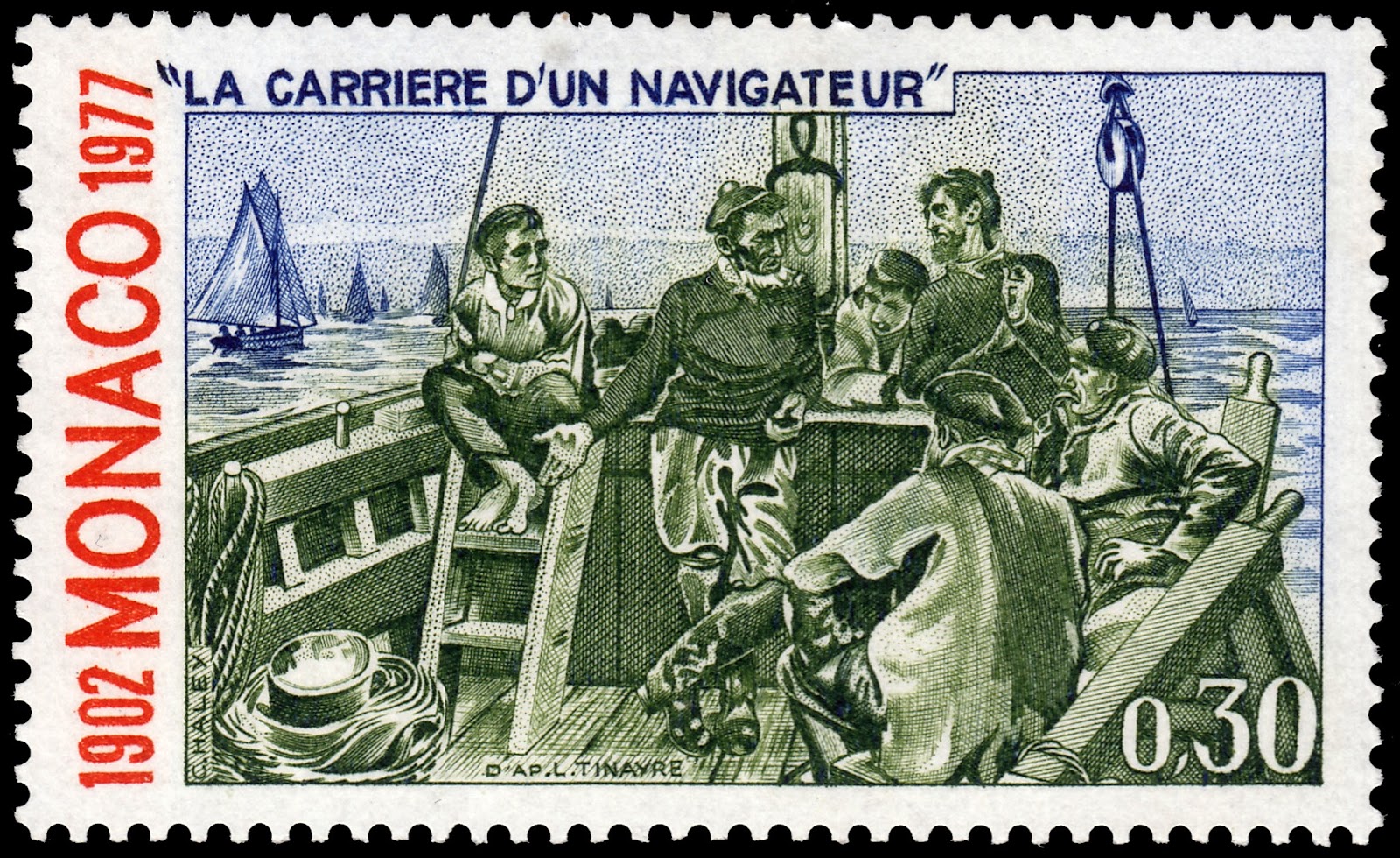
The 0,30f stamp was designed and engraved by Claude Haley. It features a lovely moment being shared by the crew members aboard one of Prince Albert I's research vessels.


***

The 0,80f stamp was designed and engraved by Michel Monvoisin. It features a splendid action shot of L'Hirondelle battling some rough weather. That wave in the background sure does look menacing!


Stay tuned for Part 2 of this gorgeous set next week!

Until then...

Thursday, 19 October 2017

Monaco 1978 - 150th Anniversary of the Birth of Jules Verne

As the saying goes: "all good things must come to an end." But over the last few weeks we have certainly been treated with a lovely set of stamp engravings by Pierre Forget for Monaco, depicting the literary talents of French writer, Jules Verne. Indeed, we have shared time with a mad clockmaker, roamed through the haunted halls of towering chateaus, followed the adventures of dangerous rescue missions across the high seas, and we have even met the odd famous face along the way, including Captain Nemo himself!

***

We have now come to the final stamp in Pierre Forget's tribute to Jules Verne, issued by Monaco in 1978. If you wish to have a recap of parts 1-5, simply click on the following links.  Part 1Part 2Part 3 Part 4, Part 5. The final stamp, which has a face value of 5,50f, is listed in the catalogues simply as "Jules Verne and allegories". A description that becomes understandable after viewing the design.


The primary feature of this design is - quite rightly - Jules Verne, himself. Surrounding the great man in a flurry of purple swirls are the seeds of story ideas, concepts made manifest in the form of still images. At the top left flies a capsule bound for the moon. In the top centre we find a less benevolent creation. One of the giant guns from Verne's dystopian story, Les Cinq cents millions de la Bégum (published in English as, The Begum's Fortune). At the bottom of the design, slicing through the swirls of creative thought, we see the sleek lines of Captain Nemo's submarine, Nautilus. The soldier on the horse to the right, I am unsure about. Anyone have any ideas?

Until next time...


Sunday, 1 October 2017

Monaco 1978 - 150th Anniversary of the Birth of Jules Verne (Part 5)


"The sea is the vast reservoir of Nature. The globe began with sea, so to speak; and who knows if it will not end with it?" 
 —Jules Verne

A shipwreck. A message in a bottle containing three cryptic clues. An epic search and rescue mission. All of this and more can be found in the pages of Jules Verne's 1867 novel, Les Enfants du capitaine Grant (The Children of Captain Grant).

The mystery begins when Lord and Lady Glenarvan of Scotland stumble across a message in a bottle. The message has been written by one Captain Grant, whose ship Britannia has gone missing, presumably wrecked. He has left behind two children, Mary and Robert. After finding the bottle, the Glenarvans petition to mount a rescue, but the government refuses. So they decide to do it themselves.  The only real clue they have from what remains of the message from the captain is latitude 37 degrees. So the expedition has no choice but to circumnavigate the 37th parallel south. The only other clues they have are a few words in three languages. These words are, of course, re-interpreted several times throughout the novel to make various destinations seem likely.

The expedition, which includes Lord and Lady Glenarvan and Grant's kids, then sets sail for South America in Lord Glenarvan's yacht, Duncan. Along the way they pick up a passenger, French geographer Jacques Paganel, who has apparently missed his steamer to India by accidentally boarding the Duncan. The expedition explores Patagonia, Tristan da Cunha Island, Amsterdam Island, and Australia.

In Australia they get what they presume to be their first solid clue. They happen upon the quarter-master of Grant's ship, Britannia, Ayrton. Then a series of coincidences that only Jules Verne could contrive occur. Firstly, it is discovered that Ayrton was actually a traitor and he'd been abandoned in Australia. As soon as the expedition members hear this, they discover that Ayrton has hijacked their ship. Believing the ship gone, the team decide to cut their losses and head back to Europe. But then the ship they are on gets wrecked off the coast of Auckland, New Zealand!

After escaping a  Māori tribe, they board a ship ... which just so happens to be the Duncan, their original vessel! Turns out the crew managed to overpower Ayrton and sail away. Then Ayrton bargains for his life by exchanging information on Captain Grant for being left on a nearby deserted island. When they get there, they can't believe their luck. Captain Grant just so happens to be living on that exact island! The successful expedition then sails off into the sunset, leaving Ayrton on the island to fend for himself. Incidentally, the rather devious character, Ayrton, reappears in Verne's later novel, L'Île mystérieuse (The Mysterious Island) published in 1874.

***

This is the fifth part in a blog series focusing on the 150th Anniversary of the Birth of Jules Verne stamp set, issued by Monaco on 2 May 1978. To check out the earlier parts, click on the individual parts. Part 1Part 2Part 3 Part 4. This beautiful set of eight stamps was designed and engraved by Pierre Forget. One of the stamps in this set features an artistic interpretation of the novel, Les Enfants du capitaine Grant.


This stunning design features Captain Grant's ship in its death throes amidst a wild storm. Watching over the storm we see two women, who i assume are Lady Glenarvan and Grant's daughter, Mary. The wild blues and melancholy greys make this a rather poignant composition.

Until next time...

Tuesday, 19 September 2017

Monaco 1978 - 150th Anniversary of the Birth of Jules Verne (Part 4)


"It is said that the night brings counsel, but it is not said that the counsel is necessarily good." —Jules Verne

High in the Carpathian mountains in Transylvania there stands a castle. A castle believed by those in the surrounding villages to be inhabited by Chort, the personification of the devil. Could this be true? Could the rumours have any validity? Does the devil in fact reside in the mountains of Transylvania? Or is it merely the product of over-imaginative superstitious minds? To seek the answer we must immerse ourselves in the pages of Jules Verne's 1893 novel,  Le Château des Carpathes (The Carpathian Castle).

Our story begins with a peddler who comes across shepherd named, Frik. The pair have an interesting conversation about the mysterious castle in the mountains, and the fantastical rumours of strange phenomena occurring in Frik's village and the nearby castle. The locals attribute these mysterious happenings to the otherworldly inhabitant of said castle. Even the local schoolteacher educates his students on the supernatural happenings in the castle. It is even said that vampires visit the village and werewolves inhabit the surrounding fields. And:
"In the depths of the forests wander the "balauri", gigantic dragons whose jaws gape up at the clouds, and the "zmei" with vast wings, who carry away the daughters of the royal blood."
The peddler seems unconvinced. Frisk continued:
"No one dared visit it. It spread around its terrible epidemic as an unhealthy marsh gives forth its pestilential emanations. Nothing could approach it within a quarter of a mile without risking its life in this world and its salvation in the next."
 Still unconvinced the peddler sells Frik a telescope, and disappears. 

Frik returns to the village, and he shows his friends the telescope. Through it they see something weird going on in the castle. They see smoke and strange lights. Is it supernatural? That night a group of villagers gather in the local pub to discuss the mystery. They decide someone needs to investigate the castle.  They settle on a two man team: the young forester, Nic Deck and Doctor Patak.

The next morning Nic Deck and Dr Patak set out on their journey. After a gruelling trek through the forest, they at last reach the castle just before dark. But they can find no way into the castle. There is no choice but to stay overnight in the woods. It is a horrible night, filled with terrifying lights and sounds and apparitions of strange creatures, while in the background the castle bells toll monotonously, as if summoning the undead from their restless slumber. The next morning the two attempt to get into the castle. Trying the climb the drawbridge chain, Nic slips and falls.

After no sight is seen of the two adventurers, the other villagers who were in the pub with them mount a rescue, all except for the teacher, who is suddenly struck with an attack of gout! Then sometime later the rescuers return with Nic on a stretcher and the doctor alongside. The Doctor relates to the villagers their frightful tale. For the next few days everyone trembles in fear at the thought of the castle. And no one dares work out in the fields.

Then one day a traveller by the name Count Franz de Telek arrives in the village. He is surprised how quiet it is. The villagers tell him about the castle and the adventure of the forester and the doctor. The Count does not believe in the supernatural. He believes there is someone at the castle playing tricks on them. But then when he finds out who owns the castle, he turns white! Baron Rodolphe de Gortz. He knows the baron. It turns out that years earlier, they were rivals for the affections of the celebrated Italian singer, La Stilla. The Count believed that La Stilla was dead, frightened to death while on stage by the strange machinations of Baron Rodolphe de Gortz! But the Baron for some reason had blamed Count Telek for the woman's death. 

Believing that Baron Ropolphe de Gortz is the man behind all this strange phenomena, the Count decides to go to the castle to put a stop to it. So the Count and his faithful servant, Rotzko, retrace the steps the two villagers took just a few days prior. When they reach the castle, the Count is dumbstruck to see a vision of his beloved La Stilla. Could she still be alive? He tells his servant to return to the village, and he sets off. After a desperate climb up into the castle, the Count goes in search of his beloved. He frantically searches the labyrinthine passages of the castle's innards.

After being trapped for a time in a crypt, the Count comes across the manservant of Baron de Gortz, a man named, Orfanik. Orfanik describes at length his master's experiments with the new technology called "electricity". Using electric machines the Baron is able to create all kinds of weird light and sound phenomena. The very phenomena that has had the village living in a state of fear for so long. Baron de Gortz is an evil man. And even more horrifying, the visions of the lady La Stilla are no more than an illusion. A projected still image of a painting of La Stilla, accompanied by a high-quality phonograph recording, creates a ghostly rendition of her. It is all a huge hoax. The moral of the story: there is no such thing as ghouls and science can explain everything! If only that were so!

***

This is the fourth part in a series focusing on the 150th Anniversary of the Birth of Jules Verne stamp set, issued by Monaco on 2 May 1978. To check out the earlier parts, click on the individual parts. Part 1Part 2Part 3. This beautiful set of eight stamps was designed and engraved by Pierre Forget. One of the stamps in this set features an artistic interpretation of the novel, Le Chateau des Carpathes.


This illustration is quite interesting. I can't be absolutely certain which two men are the main feature of the design. Is it the villagers Nick Deck and Dr Patak? Or is it Count Telek and his servant, Rotzko. I tend to think it is the former pair. For in the story,  Deck and Patak are accosted in the forest by all nature of spiritual beings. We can see these phantasms beautifully rendered in green. A prominent creature is the "balauri" found to the left. To the right we see the spiritual manifestation of the beautiful singer, La Stilla. And in the background of the design stands the mysterious castle. Graceful lines and vivid colours create a stunning stamp design, one that would look great attached to any cover!

Until next time...


Sunday, 3 September 2017

Monaco 1978 - 150th Anniversary of the Birth of Jules Verne (Part 3)


"In consequence of inventing machines, men will be devoured by them." 
 —Jules Verne
It all begins with a rather bizarre mystery. An aging clockmaker, named Master Zacharius, is shocked to discover that many of the beautiful clocks he has laboured to create over the years have inexplicably stopped working. He examines each and every clock and can find nothing wrong with them. They should all be working perfectly. But he simply cannot make them run! Why? To discover the answer we need to step into the world of Jules Verne's short story, Master Zacharius or the Clockmaker Who Lost His Soul (Maître Zacharius ou l'horloger qui avait perdu son âme). This story was first published in 1854.

Returning to Master Zacharius and his conundrum, we find him in a deteriorating state of mental health as he struggles to come to terms with the steady stream of broken clocks being returned to him. His daughter Gerande, his apprentice Aubert Thun, and his elderly servant Scholastique, who all live with him, grow increasingly concerned for the old clockmaker's health. Whilst nursing Zacharius, Gerande and Aubert Thun fall in love, an attraction that becomes important as the story progresses.

Then one day the mystery takes a weird twist when a bizarre creature suddenly walks into the village, a creature that is a grotesque amalgam of man and clock. The creature tells Zacharius quite bluntly that he is not long for this world. Zacharius scoffs at this, and replies:
"I, Master Zacharius, cannot die, for, as I have regulated time, time would end with me! … No, I can no more die than the Creator of this universe, that submitted to His laws! I have become His equal, and I have partaken of His power! If God has created eternity, Master Zacharius has created time!"
In a kind of Faustian twist, the creature offers Zacharius a way out of his dilemma. If Zacharius were to give the creature his daughter's hand in marriage, the creature promises to tell him why his clocks have all gone kaput. Zacharius flatly refuses, and the creature disappears.

But things don't get better. Quite the contrary. More clocks are returned and Zacharius' health plummets to dangerous levels. As abruptly as the creature had disappeared, Zacharius disappears from home. After a bit of detective work, his daughter, Gerande, discovers that he has travelled to a castle in Andernatt. The castle houses a grand iron clock made by Zacharius. It is the only clock of his still working. He has journeyed there to see if the clock can provide him any insight into the conundrum. Gerande indeed finds her father at the castle, running about frantically in search of the clock.

Then the old clockmaker finds it. It is a true masterpiece. It has been designed to resemble an old church, and as each new hour strikes, the clock presents a new Christian maxim for its viewers to ponder. But to his horror, the clock is not all that Zacharius finds. The creature is back! Fearing he'll never be rid of this hellish abomination, Zacharius agrees to let the creature have his daughter. Not surprisingly, the daughter is somewhat less than enthusiastic about the arrangement.

Having entered into this dubious arrangement Zacharius believes he has thwarted the creature and in doing so has granted himself immortality. But something strange happens to the clock, seeming to confirm Zacharius' choice. The Christian maxims have been replaced by statements of scientific hubris, such as: "Man ought to become the equal of God," ""Man should be the slave of Science, and sacrifice to it relatives and family."

Then, at the stroke of midnight, just when the wedding ceremony is about to take place, all hell breaks loose. First, a new, death knell, maxim appears on the clock: "Who ever shall attempt to make himself the equal of God, shall be for ever damned!" Suddenly the massive clock bursts, spraying bits and pieces of machinery across the room. Zacharius frantically tries to gather the pieces, believing that the clock, as a whole, represents his soul. But the creature seizes what is left of the clock and disappears again. Seeing this, Zacharius drops dead on the spot. The one good thing that comes of this story is Gerande and Aubert get married and spend their life together. And the diabolical creature is never seen again.

***

This is the third part in a series focusing on the 150th Anniversary of the Birth of Jules Verne stamp set, issued by Monaco on 2 May 1978. To check out the earlier parts, click on the individual parts. Part 1, Part 2. This beautiful set of eight stamps was designed and engraved by Pierre Forget. One of the stamps in this set features an artistic interpretation of the short story, Master Zacarius. It illustrates Zacharius holding a rather demonic-looking clock. In the background we see the castle where the final scenes take place. And off to the right stand the frightened couple, Gernade and Aubert. This is quite a magical representation of the story with bright colours and vibrant, energetic lines.


Until next time...

Sunday, 20 August 2017

Monaco 1978 - 150th Anniversary of the Birth of Jules Verne (Part 2)

"A man of merit owes himself to the homage of the rest of mankind who recognize his worth."
—Jules Verne

Strange lights spotted in the night sky the world over. Haunting trumpet sounds that accompany these sightings. Add to this the mysterious appearance of black flags worked with golden suns atop many of the world's most famous monuments, including The Great Pyramid, The Effiel Tower, and The Statue of Liberty. What could all this weirdness be? Aliens with a twisted sense of humour? Not this time. This quirky behaviour is the work of none other than Robur, a brilliant inventor and the main character in Jules Verne's 1886 novel, Robur the Conqueror

This blog is the second part in a series focusing on the 150th Anniversary of the Birth of Jules Verne stamp set, issued by Monaco on 2 May 1978. To check out Part 1, click HERE. This beautiful set of eight stamps was designed and engraved by Pierre Forget. One of the stamps in this set features a key scene from the novel Robur the Conqueror.

***

The story-line of this novel is rather intriguing considering its year of publication. The central theme of the novel is the argument over the feasibility of heavier-than-air versus lighter-than-air flying craft. But before we go any further with the description of the novel, let's have a look at a bit of history. Since the invention of the hot air balloon in 1783 by Joseph and Etienne Montgolfier in France, inventors had been wracking their brains trying to find a way to successfully propel and steer these craft contrary to wind conditions. In other words, wrest the steering wheel from Mother Nature. For nearly 100 years this seemed an impossible task (Mother Nature had a tight grip on the wheel!). Then in 1886 Gottlieb Daimler created a light-weight gasoline engine suitable for lighter than-air-craft. This engine led Count Zeppelin of Germany to develop a solid-frame craft covered in fabric, powered by two 16 hp Daimler engines. This craft was 416 feet long. This craft, known as the LZ 1, flew successfully for a full 18 minutes in July 1900. It was the first ever airship or "blimp" as we now call such a craft. 

So it was in this early environment of inventors pulling their hair out, searching for controllable lighter-than-air flying craft that Jules Verne's novel is set. In the story, the main character, Robur, is trying to convince the movers and shakers of the Weldon Institute, a flight enthusiasts group in Philadelphia, that lighter-than-air flight is a thing of the past. Robur argues with them that heavier-than-air flying craft is the way of the future - and he has proof! Robur boasts that the strange lights are his new aircraft and that it was he who placed the black flags the the famous monuments. The Weldon guys basically consider him a crackpot and laugh at him.

The arrogant Robur then decides, perhaps rashly, to kidnap the Weldon Institute's secretary, president, and the president's valet, and takes them aboard his new flying machine. Robur calls this machine the Albatross. He explains that it is a multi-rotor gyrodyne with many horizontally-set airscrews to provide lift and two vertically-set airscrews to drive the vessel forward and to provide control. Oh, and the whole apparatus is battery powered! Like a lot of early sci-fi writers, Jules Verne had a rather scarily accurate insight into future technology.

To cut a long story short, the Weldon guys didn't particularly like being kidnapped. Surprise, surprise! And they are ridiculously jealous of this new technology. It far surpasses anything they have designed. In order to exact some Victorian gentlemanly revenge and remove the competition, they decide to blow the ship up and make their escape. Believing this flying craft destroyed, the Weldon Institute wait a few months, then unveil their own new lighter-than-air craft, which is basically a hot air balloon with a small motor (a forerunner to the Zeppelin). They call it Go-Ahead. They launch it and start wowing the crowds with its capabilities.

Unbeknownst to the Weldon guys, Robur has secretly built a second Albatross using parts recovered from the wreck. He appears out of nowhere with his new ship and starts showing the crowds just how much better his craft is by literally running rings around the Go-Ahead. During the competition the two flying craft go higher and higher. Then disaster struck for the Go-Ahead. Its gas bags, unable to handle the altitude, rumble, quiver, and... EXPLODE!  Robur rescues the crew of Go-Ahead.

In one final display of arrogance, Robur then tells the crowds that the world is not ready for his technology yet. And he promptly flies his vessel off into the sunset.

***

Now let's look at Pierre Forget's artist impression of the battle in the sky between the two vastly different flying craft. It is stunning work, in my humble opinion. I love Forget's depiction of the moving airscrews. And the great use of red to represent the sense of height and the imminent mortal danger faced by those in the hot air balloon.


Until next time...


Wednesday, 9 August 2017

Monaco 1978 - 150th Anniversary of the Birth of Jules Verne (Part 1)

 "It is certain that the inanimate objects by which you are surrounded have a direct action on the brain."
—Jules Verne
The inanimate objects currently surrounding me just happen to be stamps, stamps celebrating the sesquicentennial of the French sci-fi novelist, Jules Verne (for more on M. Verne click HERE). And I have to say these wonderful engraved stamps are definitely having a direct action on my brain - a very positive one. This set was issued on 2 May 1978 in Monaco, 150 years after the birth of Jules Verne on 8 February 1828 in Nantes, France. This set is quite a large one, consisting 8 stamps, all of which were designed and engraved by Pierre Forget. For the sake of brevity, I will study the first three stamps in the set in this blog. These three stamps focus on the novel, L'Île mystérieuse (The Mysterious Island). 

***

The Mysterious Island is a novel set during the Siege of Richmond at the end of the American Civil War in 1865. Five Union soldiers, who are being held as prisoners of war, decide to escape their confinement by hijacking a balloon. Stealthy! Unfortunately for the escapees, the weather is in rather a bad mood. After travelling for some distance over the Pacific Ocean, a storm grabs the balloon and tosses it to ground on a strange uncharted island in the South Pacific. This balloon crash is the subject of the first stamp.


Lucky to be alive, the survivors call their savior 'Lincoln Island' in honour of President Lincoln. Thankfully for the castaways, one of their number happens to be a brilliant engineer (shades of the Professor in Gilligan's Island here!). The engineer, called Smith, managed to produce fire, pottery, bricks, nitroglycerin, iron, a simple electric telegraph. And if that wasn't enough, he designed for them a home on one of the island's cliffs. They called it 'Granite House'. Taking this ridiculous fantasy world even further, they built a seaworthy ship!

As the castaways settle into life on the island - which is starting to sound pretty luxurious to me - a series of strange mysteries begin to unfold. It seems the men have an anonymous benefactor who helps them along with gifts such as weapons and ammunition. And their dog 'Top' is rscued in the water from a dugong by an unseen hand. Just who or what is this deus ex machina (god from the machine)?

Then one day they find a message in a bottle directing them to rescue a castaway on nearby Tabor Island. The group rescue the man, who turns out to be Tom Ayrton, a character from another Verne story In Search of the Castaways. This man was once a crew member on a pirate ship! On their way home they are struggling to find their island in a sudden storm when the mysterious benefactor strikes again. A signal fire has been lit to guide them home.

Things then go rather crazy when the pirate ship also finds the island. After the pirates unsuccessfully attempt to take Granite House their ship suddenly blows up! This brings us to the next stamp. Note the strange silhouette in the water beneath the ship. This is a clue as to the identity of the benefactor.


Rather annoyed with the destruction of their ship, the surviving pirates kidnap Tom Ayrton. Our castaways try to get Aryton back, but one of them,. Harber, is shot, seriously wounding him. He survives, but he's so weak that he contracts malaria. Enter the benefactor again. He leaves a box of quinine sulphate, which saves Haber.

After Harbert recovers, they set out again to rescue Ayrton and destroy the pirates once and for all. When they discover Ayrton he is alive and well, and the pirates are all dead, without any visible wounds. Suddenly, a figure emerges in a strange helmet...


The figure is the mysteriois benefactor in the flesh. He removes his helmet, revealing himself to be none other than... Captain Nemo! After his adventures in 20,000 Leagues Under the Sea, Nemo has sailed his Nautilus (the strange silhouette under the water in the last two stamps) to the island to live in isolation (an idea that didn't work out all that well).

Until next time...


Monday, 22 May 2017

Monaco 1975 - Carmen: Act IV

They say variety is the spice of life! So to make the month of May nice and spicy I have dedicated the entire month to the four stamp 1975 Monaco series celebrating the 100th anniversary of the opera Carmen. The set was issued on 13 May and it was designed and engraved by Albert Decaris. Since Carmen is in four acts and each of these acts has been illustrated with its own stamp, each week's blog has been a "one act wonder" so to speak. This week it is time for Act IV. The finale! If you wish to review any or all of the story so far, here are the links to each Act of the opera. Act I. Act II. Act III.

As I have mentioned in the previous three blogs dedicated to this opera, Carmen is a tale of seduction, passion, infidelity, jealousy and murder. It was first performed at the Opéra-Comique in Paris on 3 March 1875. It was considered quite scandalous for its time! 

***

Act III ended with José heading back down to the town after having been convinced that his mother is ill and needs him. But before he leaves he tries to prevent Carmen from rushing off into the arms of Escamillo. Let's see how that panned out!


ACT IV

The lights come on. We are in the square in front of the bull-fighting arena at Seville, Spain c. 1920. It is the day of the bull-fighting contest.

The square is jam-packed with people. Merchants are crying their wares. Gypsies are performing for the crowds. It's party-time! The attention soon focuses on the two friends of Carmen, Frasquia and Mercédès. They are talking to the soldier, Zuniga (he is the guy José has had a couple of entanglements with). They tell him that Carmen is now with Escamillo.

Then the bull-fighters arrive and the crowd goes wild. Carmen is indeed with Escamillo. They openly express their love in front of the crowd. Carmen cries out that she has never loved anyone as much as Escamillo.

As Escamillo goes into the arena surrounded by screaming fans, Frasquita pulls Carmen aside and warns her that José is somewhere in the crowd. Carmen looks at her and blows her off. She turns, about to enter the arena, when José appears and grabs her. He is desperate. She tries to pull away but he begs her to stay with him. He says that they can move away and have a new life together. If only she will love him back. She pauses, perhaps considering the request. But then she tells him quite bluntly that she does not love him at all. 

Suddenly cheers erupt from the arena in the background. Carmen desperately wants to go in, but José, relentless, won't let her. He begs her yet one more time. This time Carmen replies with a scornful rebuke. José becomes incensed. Then, as the crowds in the arena are chanting the name "Escamillo" José pulls out a knife and plunges it into Carmen's heart (I am assuming heart!). As Carmen drops to the ground dead, a chorus of the "Toreador Song" can be heard in the background.

José kneels over the body of Carmen, declaring his guilt over her murder, as the crowds pour out of the arena. We are then left to ponder the fate of José. Is he punished by the law for his deed? Does Escamillo take revenge on the killer of his lover? Or does José flee to live out the rest of his life in guilt-ridden torment? 

***

Time to reveal the Act IV - and final - stamp!


What a beautiful stamp! In he foreground we see Carmen and Escamillo in a lovers' embrace. While off to the right, we see José staring them down, perhaps plotting some way of winning back the love of Carmen? Just check out the engraved detail of Carmen's dress. Not to mention the gorgeously-rendered bull-fighting arena in the background. Just...Wow!

So, there you have it. The four Acts of Carmen and the corresponding stamps. What an amazing set! Bravo, Albert Decaris! A superlative polyptych piece of art. Which stamp was your favourite? I really can't decide...

Until next time...


Wednesday, 17 May 2017

Monaco 1961 - Vintage Cars

Men in their driving coats, stout gloves, caps with goggles, and crisp, white scarves. Women in their fur-lined coats and jaunty hats. Shiny automobiles, their brass fittings gleaming in the sun, their gas lamps primed, the spoked wheels and leather seats polished. This was the dawn of the age of the automobile. A golden age of beautifully constructed machines. Rolling works of art.

***

On 13 June 1961 Monaco issued a charming set of 14 stamps celebrating the beauty of the antique automobile. Two of the stamps in this set were engraved by Pierre Gandon. The 10c and 30c values. These two stamps will be the focus of this blog.

The 10c value depicts an 1899 Panard-Levassor. The AL model.


The company known as Panhard et Levassor, was a French car manufacturer, established by René Panhard and Émile Levassor in 1887. They sold their first automobile in 1890, a vehicle based on a Daimler design. For more on the evolution of the Panard Motor Company, click HERE.

By 1891 they began incorporating their own features to the vehicles. In fact, their designs set the groundwork for many modern standards. They were the first to incorporate a clutch pedal to operate a chain-driven gearbox. Their deign was also the first to feature a front-mounted radiator. It is also believed that the 1895 Panhard et Levassor included the first modern transmission. And if this ere not enough technical innovation. The automobile Panhard et Levassor entered into the 1894 Paris–Rouen Rally came equipped with a steering wheel, This is believed to be one of the earliest uses of this apparatus. 

A French Magazine, dated 6 Aug 1894, advertising the Paris-Rouen race...

***

The 30c value depicts a 1901 FN Herstal.


The Fabrique Nationale d'Herstal (National Factory of Herstal), is a firearms manufacturer, located in Herstal, Belgium. The company is usually identified by the name: FN Herstal, or simply FN. The company was originally established in 1889 to manufacture 150,000 Mauser Model 89 rifles ordered by the Belgian Government. In 1899 FN Herstal also began manufacturing automobiles.

The very first FN automobile was in the style of the horse-drawn dog cart, which was commonly used by sport shooters. It had a twin-cylinder engine with a chain-drive, and a two-speed gearbox. The company continued to sell this style of automobile through to 1906. By 1939 the company stopped making automobiles.

Until next time...


Monday, 15 May 2017

Monaco 1975 - Carmen: Act III

Carmen is an opera that involves seduction, passion, infidelity, jealousy and murder. It was first performed at the Opéra-Comique in Paris on 3 March 1875. It was considered quite scandalous for its time, and the reviews and audience reactions were far from positive. In fact, the opera was more popular overseas. and it wasn't revived in Paris until 1883, eight years after its initial release.

***

On 13 May 1975 Monaco issued a set of four stamps to celebrate the 100th anniversary of the premiere of the opera, Carmen. This beautiful set of stamps was designed and engraved by Albert Decaris. Each stamp represents one of the four Acts of the opera. In the last couple of blogs we were introduced to Carmen with an in-depth look at Act I and Act II of the opera and their related stamps. Click HERE to read about Act I. And HERE for Act II.

***

Act II ended with Carmen, José, and a couple of smugglers fleeing the Inn together to get away from the senior officer with whom José had just fought. So what will happen to the runaways...?

ACT III

The lights come on. We are deep in the wilds of the mountains near Seville, Spain c. 1920. It is night time.

Carmen, a couple of her friends, José, and the smugglers are travelling further into the mountains. At some point during the journey, Carmen has become bored with the company of José. Hoping to be rid of him she starts taunting him and telling him to go back to the village. But he knows he can't. After fighting a superior officer, he would be charged immediately.

They find a spot to hide. Carmen's friends, Frasquita and Mercédès, pull out a set of fortune-telling cards to kill some time. Carmen joins them, they read her fortune. Carmen is stunned when they tell her that the cards foresee hers and José's deaths. Watching the women, the smugglers get an idea. They decide to take the women down into the town to the customs officials and have them use their feminine charms on them in order to move their contraband. They leave José there alone with the stash.

Not long after, José's sweetheart, Micaela (who we met in Act I), comes into the mountains. She spots José before he sees her. She is about to approach him when she hears him fire his gun. She hides behind some rocks, thinking he might be shooting at her. But she soon finds out that he actually is shooting at a man approaching. The man resolves from the shadows. It is Escamillo, the toreador. José, recognising the toreador, relaxes his guard and the two start chatting. 

However, the atmosphere soon becomes tense when Escamillo starts talking about a woman he has fallen for, a woman named, Carmen. And worse still Escamillo says that she seems infatuated with some common soldier. He has no idea the soldier is José! Enraged, José challenges him to a knife fight. But Escamillo merely defends himself and doesn't fight back. Now José is really annoyed! He comes at the bullfighter again. Escamillo manages to get the better of him, but lets him go. He says he fights bulls not men! José attacks him for a third time. This time Escamillo's knife breaks. José has a chance...

...but then Carmen reappears with the smugglers. Escamillo takes the opportunity to leave. But before he does, he invites Carmen and the smugglers to his next bullfight in Seville. As Escamillo departs, Micaela is spotted hiding in the rocks. She comes out and begs José to return home with her as his mother is very sick. Carmen mocks him, telling him to run along home. After some more begging by Micaela, José agrees to go, but he promises Carmen he will return to her.

As José starts to walk off, the voice of Escamillo singing the toreador song can be heard. Carmen's eyes light up and she makes to dash off to find him. But José turns around and stops her from leaving...

***

Time for the Act III stamp.


In this lovely engraving Decaris has decided to capture the moment when Micaela starts begging José to return home with her. Micaela's dress has been picked out n stunning green. And the sash around José's waist is also green, illustrating their connection. 

In this image we can clearly see José's reluctance to leave with Micaela by his posture. And to the left we see Carmen, standing there, mocking him. If you look closely you see the rose José gave her between her breasts. Perhaps taunting José. Again, a splendid composition!

Until next time... 

Sunday, 7 May 2017

Monaco 1975 - Carmen: Act II

Carmen is an opera that involves seduction, passion, infidelity, jealousy and murder. It was first performed at the Opéra-Comique in Paris on 3 March 1875. It was considered quite scandalous for its time, and the reviews and audience reactions were far from positive. In fact, the opera was more popular overseas. and it wasn't revived in Paris until 1883, eight years after its initial release.

An Early Carmen Poster

On 13 May 1975 Monaco issued a set of four stamps to celebrate the 100th anniversary of the premiere of the opera, Carmen. This beautiful set of stamps was designed and engraved by Albert Decaris. Each stamp represents one of the four Acts of the opera. In last week's blog we were introduced to Carmen with an in-depth look at Act I and the first stamp in the set. Click HERE to read about Act I.

***

Act I ended with Carmen tricking a soldier named, José Morales, to let her go after she had attacked a workmate with a knife. So what next? Let the curtain rise for...

ACT II

The lights come on. We are in an Inn owned by Lillas Pastia, in Seville, Spain c.1820. Two months have elapsed since the events of Act I.

Carmen is partying at the Inn with some friends and entertaining the soldiers present. One of the soldiers is Zuniga, the officer who arrested Carmen in Act I for wielding the knife. He approaches Carmen and tells her that José has just been released from his two month imprisonment for letting her go. She is delighted at this news! Probably because she starts thinking how she can further manipulate the poor guy.

Suddenly there is noise outside as a procession approaches, announcing the arrival of the toreador, Escamillo. Toreador's were like rock-stars back then. Escamillo enters and announces himself with the "Toreador Song". He grabs a drink and makes a toast: Votre toast, je peux vous le rendre! Then he sees Carmen and makes a beeline for her. But Carmen ignores him.

Then the owner of the Inn, Lillas Pastia, gets rid of the crowds and the soldiers. Only Carmen and her two friends remain. They are chatting, when two shady-looking characters enter. These guys are smugglers. They tell Carmen and her friends that they want to get rid of some contraband they just got their hands on. Carmen isn't interested, but her two friends are. Carmen is only interested in seeing José again. The smugglers give up and leave.

A short time later, José turns up. Carmen immediately launches into a private exotic dance just for him. Je vais danser en votre honneur (I will dance in your honour). But Carmen's intimate dance is rudely interrupted by the bugle call from the soldier barracks. José turns to leave, which angers Carmen. She obviously thinks he doesn't really like her after all. But José produces the rose that Carmen had thrown at his feet in Act I. This romantic act is seemingly not enough to impress Carmen. She mocks him, and tells him that the only way she will possibly believe him is if he runs away with her, abandoning his military post. José flatly refuses. He doesn't want to desert.

He is about to leave and return to the barracks when his officer, Zuniga, returns. Zuniga obviously has the wrong idea, thinking that José is planning to run away with Carmen. The two men fight. During the fight, the smugglers return and separate the pair. Unfortunately, José has now dug himself a grave by assaulting a superior officer. He now has no choice but to flee the scene with Carmen and go into hiding. They quickly leave the Inn with the two smugglers...

***

Now it is time to reveal the stamp for Act II.


This lovely stamp, with its sumptuous use of deep red, draws us into the Inn of Lillas Pastia. The main focus of the design is Escamillo, the toreador, singing to Carmen and her friends. He is in red. Decaris has placed bull heads in the top corners of the design to remind us of Escamillo's bull-fighting prowess. These are also in red. In the background to the left we see another figure in red. This is José. Lurking, waiting to enter the scene. Much like the toreador was lurking off to the side in the first stamp. Decaris' use of red to highlight the central themes of the Act is a stroke of genius.

***

The attention to detail in this stamp is incredible. Especially striking are the women's costumes.


Until next time...


Tuesday, 2 May 2017

Monaco 1975 - Carmen: Act I

A story of seduction, passion, infidelity, jealousy and murder. The essential ingredients of a good crime thriller. But what about an opera? Surely an opera with such themes would be scandalous! Well, such an opera does exist, and, yes. when first performed it was quite the scandal. This opera was Carmen.

***

Carmen is an opera presented in four acts. (I intend to replicate this four act structure for my Carmen blog series, but more on that later). The opera was composed by Georges Bizet, a French composer. The libretto of Carmen was written by Henri Meilhac and Ludovic Halévy, The libretto is basically the text portion of an opera. The libretto for Carmen was based on a novella of the same title by Prosper Mérimée. 

Carmen was first performed at the Opéra-Comique in Paris on 3 March 1875. The reviews and audience reactions were far from positive. In fact, the opera was more popular overseas. and it wasn't revived in Paris until 1883, eight years after its initial release. 

Opening Night Poster

So what was this seemingly controversial opera about? The story is set in southern Spain, and it focuses on a young soldier by the name of José Moralès. At the beginning of the story José seems happy; he has a steady job, and he is sharing his life with his childhood sweetheart. That is until Carmen enters the picture. Carmen is a gypsy with fiery passions. She seduces José, who falls for her charms. Unfortunately like many love-struck young men in stories, he abandons his life to be with Carmen. But Carmen is just using him. She in turn abandons José and turns her attention to an attractive toreador, Escamillio. In a fit of jealous rage, José kills Carmen. If he can't have her love, no one can! Carmen's tragic death actually takes place on-stage. Slaying your main character is a risky strategy. Probably one of the main reasons for the lack-lustre reviews upon its premiere in 1875.  

***

On 13 May 1975 Monaco issued a set of four stamps to celebrate the 100th anniversary of the premiere of the opera, Carmen. This beautiful set of stamps was designed and engraved by Albert Decaris. Each stamp represents one of the four Acts of the opera. Since this set was issued in May and it now is May, I have decided to do something a little different this time around. Instead of showing all four gorgeous stamps at once, I am going to do them one Act at a time. That will amount to one Act each week for the month. So without further ado, let the curtain rise for...

ACT I

The lights come on. We are in a square, in Seville, Spain c.1820. To the right, we can see a door to the tobacco factory.  To  the left, we see a guardhouse. And at the rear of the stage there is a bridge.


There is a small group of soldiers standing about, chatting with each other in the square, while waiting for the changing of the guard. A woman approaches, named Micaëla. She asks after José Moralès. They tell her he will arrive with the change of guard. She leaves, promising to return later. Then the new guard arrives, and with them José Moralès.

Shortly after this the cigarette factory bell rings, and a large group of young women emerge. One of the women is Carmen. She approaches the soldiers and starts singing L'amour est un oiseau rebelle (Love is a rebellious bird). A song designed to inflame their passions. Many of the men start begging to be her lover. José Moralès is not one of the men. But she chooses José Moralès by throwing a rose at his feet. He is annoyed with her and doesn't respond. If only he had stuck to his guns!

Then things start to heat up a bit. The women go back to the cigarette factory. Micaëla returns to find José. She gives him a letter and a kiss from his mother. He says, "Parle-moi de ma mère!" (Tell me about my mother). In the letter, his mother tells him to return home and marry Micaëla so they can live happily ever after. He is about to say yes...

When there is a sudden commotion at the cigarette factory. An officer emerges with a very angry Carmen. He tells José that she attacked another woman with a knife. Carmen cries out, "Coupe moi. Brûle-moi!" (Cut me. Burn me). José is ordered to bind her hands and take her to the prison. 

After everyone leaves, Carmen seizes the opportunity to sing to José about what it would be like to spend a passion-filled night with her, He is bewitched by her. Spellbound, he unties her bonds. Then she pushes him to the ground, throws her head back in laughter, and runs away. Poor José is then arrested for dereliction of duty.

***

Now we come to the stamp. Decaris has captured the theme of Act I beautifully. 


In the background we can make out the sets. The factory. The guardhouse. And the bridge. 


In the foreground we see Carmen flirting with José Moralès. She is smoking a cigarette to suggest of being a worker in the cigarette factory. And if we look closely we can see the rose in Carmen's mouth, ready to be thrown at José's feet. 


And despite the fact that the toreador has yet to enter the story, Decaris has decided to depict him off to the right, looming, yet to be engaged. But he is there. A reminder of the love triangle to come. 


Stay tuned for Act II next week!

Until then....

Sunday, 29 January 2017

Monaco 1953 - Gancourt Journal

Ever wondered if it were possible to work side by side with your sibling every day of your life? Not really your speed? Well, this arrangement seemed to work for the French brothers, Edmond de Goncourt (1822–96) and Jules de Goncourt (1830–70). The Goncourt brothers not only worked together as writers, they were inseparable in their regular lives.
"Not only did they write all their books together, they did not spend more than a day apart in their adult lives, until they were finally parted by Jules's death in 1870." (Kirsch, 2006)
The brothers began their writing career after a "sketching holiday", about which they later wrote. Books detailing French and Japanese society and art followed soon after. Among several novels and a series of history books, they kept a journal which provides the reader with an intimate glimpse into the world of French literary society of the late 1800's.


***

On 29 June 1953 Monaco issued a stamp to commemorate the publication of the Journal des Goncourt, 1851-1896 written by the brothers Edmond de Goncourt and Jules de Goncourt. This truly gorgeous stamp was engraved by Pierre Gandon, And he did a sterling job on this one.

The image on the stamp is based on a book-plate for the journal, which was designed by Paul Gavarni. The etching for the book-plate was done by Jules Gancourt (I'd like to thank Natalie for providing me with information on the book-plate).

The image on the stamp - and book-plate - depicts a hand, presumably belonging to one of the brothers, caressing the manuscript of the journal. There are two fingers on the manuscript, one for each brother. And each finger is pointing to the initial of one of the brothers. Two quills standing poised to be picked up and used to scribble a few insightful words and a row of books in the background add a creative feel to the image. All in all, a fantastic composition.

Interestingly, during the design stage of this stamp Gandon only drew one quill in his proof. He sent this proof to Prince Rainier who liked what he saw but jokingly commented that with only one quill there would be fights over which brother got to use it. Gandon promptly added a second quill.

Until next time...

----------------

References:

Kirsch, A (2006), Masters of indiscretion, The New York Sun (Aug 29).